

Prosthetics and Orthotics
Prosthetics replaces missing body parts, while orthotics supports or guides existing body segments. Both use clinical biomechanics and person-centered goals to improve mobility, independence and participation.
General subject summary is free to everyone.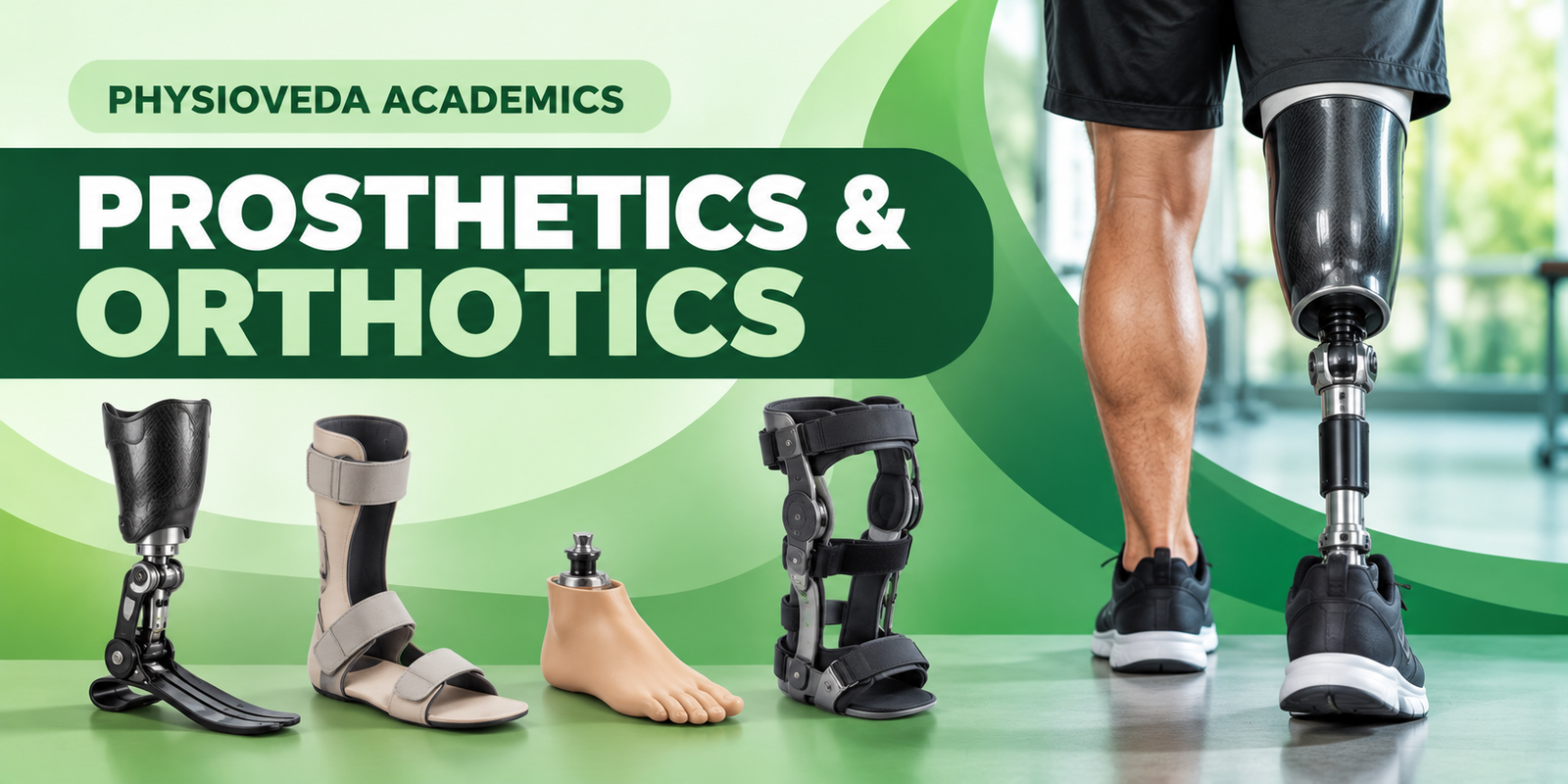
Prosthetics and Orthotics
Subject Summary
The public overview below follows the supplied PhysioVeda Academics subject summary.
Prosthetics replaces missing body parts, while orthotics supports or guides existing body segments. Both use clinical biomechanics and person-centered goals to improve mobility, independence and participation.
The rehabilitation process spans assessment, device prescription and fabrication, fit and alignment review, physical training, skin protection, maintenance and re-evaluation as functional needs change.
High-yield reasoning links residual-limb anatomy or joint impairment with the chosen interface, force distribution, component behavior and the person’s actual performance in daily activities.
This summary follows all 12 topics and 64 listed subtopic entries in the uploaded PhysioVeda Academics outline. Descriptions and practice examples beyond the headings are educational synthesis, not quoted text from the outline.
Whole-subject high-yield numbers
Use these supplied values and key facts for quick whole-subject revision.
| Item | Number / key fact |
|---|---|
| Prosthesis versus orthosis | Prosthesis replaces a missing body part; orthosis supports, protects, positions or guides an existing body segment. |
| Three-point force system | One primary corrective force is countered by two forces in the opposite direction; pressure distribution and skin protection are essential. |
| Prosthetic prescription | Match device and components to limb level, residual-limb condition, strength, goals, balance, cognition, environment and resources. |
| Prosthetic fit | Socket load distribution, volume accommodation and secure suspension jointly determine comfort and control. |
| Amputation level | More proximal limb loss generally reduces biological joint control and increases energy and component demands. |
| Residual-limb safety | New skin breakdown, persistent pressure, pain or changing limb volume requires review before increasing device use. |
| Pre-prosthetic priorities | Wound healing, edema management, contracture prevention, conditioning, transfers and balance precede advanced gait training. |
| AFO / KAFO / HKAFO | AFO spans ankle-foot; KAFO adds the knee; HKAFO adds hip control and is more complex to use. |
| Gait deviation analysis | Investigate fit, alignment, range of motion, strength, motor control, limb length, confidence and terrain together. |
| Assistive-device prescription | Base cane, crutch, walker or wheelchair selection on safety, weight-bearing status, stability, endurance and participation. |
Core references
- Chui KK, Jorge M, Yen S-C, Lusardi MM. Orthotics and Prosthetics in Rehabilitation. 4th ed. Elsevier; 2019.
- Lusardi MM, Jorge M, Nielsen CC. Orthotics and Prosthetics in Rehabilitation. 3rd ed. Elsevier; 2012.
- World Health Organization. WHO Standards for Prosthetics and Orthotics: Part 1, Standards; Part 2, Implementation Manual. WHO; 2017. https://www.who.int/publications/i/item/9789241512480
- American Academy of Orthopaedic Surgeons. Atlas of Amputations and Limb Deficiencies: Surgical, Prosthetic, and Rehabilitation Principles. Relevant chapters on levels of limb loss and rehabilitation.
- Hsu JD, Michael JW, Fisk JR, editors. AAOS Atlas of Orthoses and Assistive Devices. American Academy of Orthopaedic Surgeons. Relevant chapters on spinal, upper-limb and lower-limb orthoses.
- Practice note: These are general study principles; device choice, fitting and patient-specific loading or wear schedules require individual clinical assessment by qualified professionals.
Want to go deeper into Prosthetics and Orthotics?
Continue into the complete topic and subtopic learning system with structured summaries, medical visuals, topic wise OBQ practice, timed tests, explanations and results.