

Exercise Therapy
Learn therapeutic exercise, mobility, strength and function.
General subject summary is free to everyone.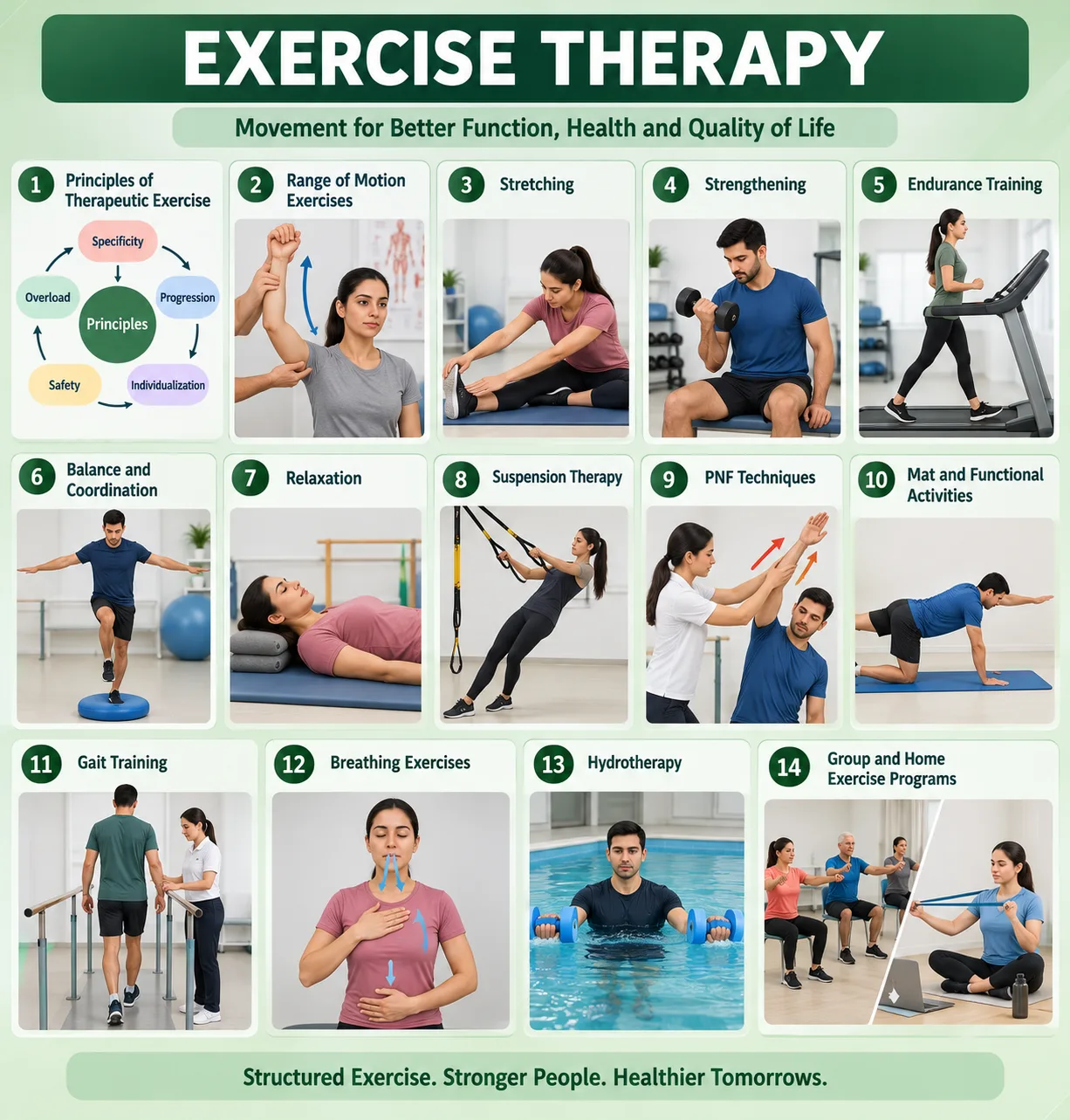
Exercise Therapy
Subject Summary
The public overview below follows the supplied PhysioVeda Academics subject summary.
Exercise therapy is the planned use of movement, physical activity and therapeutic exercise to restore or maintain mobility, strength, endurance, balance, coordination, breathing efficiency and functional independence.
The central principle is specificity: the exercise selected should match the impairment, activity limitation and functional goal while remaining safe and appropriately dosed.
Therapeutic exercise progresses from protection and assisted movement toward active control, resistance, endurance and task-specific retraining as the patient improves.
Monitoring includes symptoms, movement quality, fatigue, vital responses when indicated, pain behavior, compensations and post-exercise recovery.
This document follows 14 major topics: principles, ROM, stretching, strengthening, endurance, balance/coordination, relaxation, suspension, PNF, mat/functional activity, gait, breathing, hydrotherapy and group/home programs.
Whole-subject high-yield numbers
Use these supplied values and key facts for quick whole-subject revision.
| Item | Number / key fact |
|---|---|
| FITT-VP exercise prescription | Frequency, Intensity, Time, Type, Volume, Progression |
| Common Borg RPE scale | 6-20 |
| Common CR10 perceived-exertion scale | 0-10 |
| General static stretch hold | Often 10-30 s in adults; longer holds may be used in older adults |
| Common flexibility repetitions | 2-4 repetitions per muscle group |
| Typical strengthening repetition range | Often 8-12 reps/set for general strengthening; task dependent |
| General resistance-training frequency | Commonly 2-3 days/week per major muscle group |
| Moderate aerobic intensity | Approx. 40-59% HRR or VO2R; ~64-76% HRmax |
| Vigorous aerobic intensity | Approx. 60-89% HRR or VO2R; ~77-95% HRmax |
| General adult aerobic target | About 150 min/week moderate or 75 min/week vigorous, when medically appropriate |
| Standard bilateral axillary crutch gait patterns | Commonly 2-point, 3-point, 4-point and swing patterns |
| Traditional PNF diagonal patterns | Upper- and lower-extremity D1 and D2 patterns |
Core textbook set used throughout
- Kisner C, Borstad J, Colby LA. Therapeutic Exercise: Foundations and Techniques. 8th ed. F.A. Davis; 2023.
- Brody LT, Hall CM. Therapeutic Exercise: Moving Toward Function. 4th ed. Wolters Kluwer; 2018.
- Fulk GD, Chui KK, eds. O'Sullivan & Schmitz's Physical Rehabilitation. 8th ed. F.A. Davis.
- American College of Sports Medicine. ACSM's Guidelines for Exercise Testing and Prescription. 12th ed. Wolters Kluwer; 2025.
- Gardiner MD. The Principles of Exercise Therapy. 4th revised ed. CBS Publishers & Distributors; 2023 reprint/revised edition.
- Adler SS, Beckers D, Buck M. PNF in Practice: An Illustrated Guide. 4th ed. Springer; 2014.
- Brody LT, Geigle PR. Aquatic Exercise for Rehabilitation and Training. Human Kinetics; 2009.
Want to go deeper into Exercise Therapy?
Continue into the complete topic and subtopic learning system with structured summaries, medical visuals, topic wise OBQ practice, timed tests, explanations and results.