

Musculoskeletal Physiotherapy
Musculoskeletal physiotherapy evaluates and manages disorders affecting muscles, tendons, ligaments, joints, bones, peripheral nerves and related movement systems. The emphasis is on restoring function, improving load tolerance and supporting confident participation in daily, occupational and recreational activity.
General subject summary is free to everyone.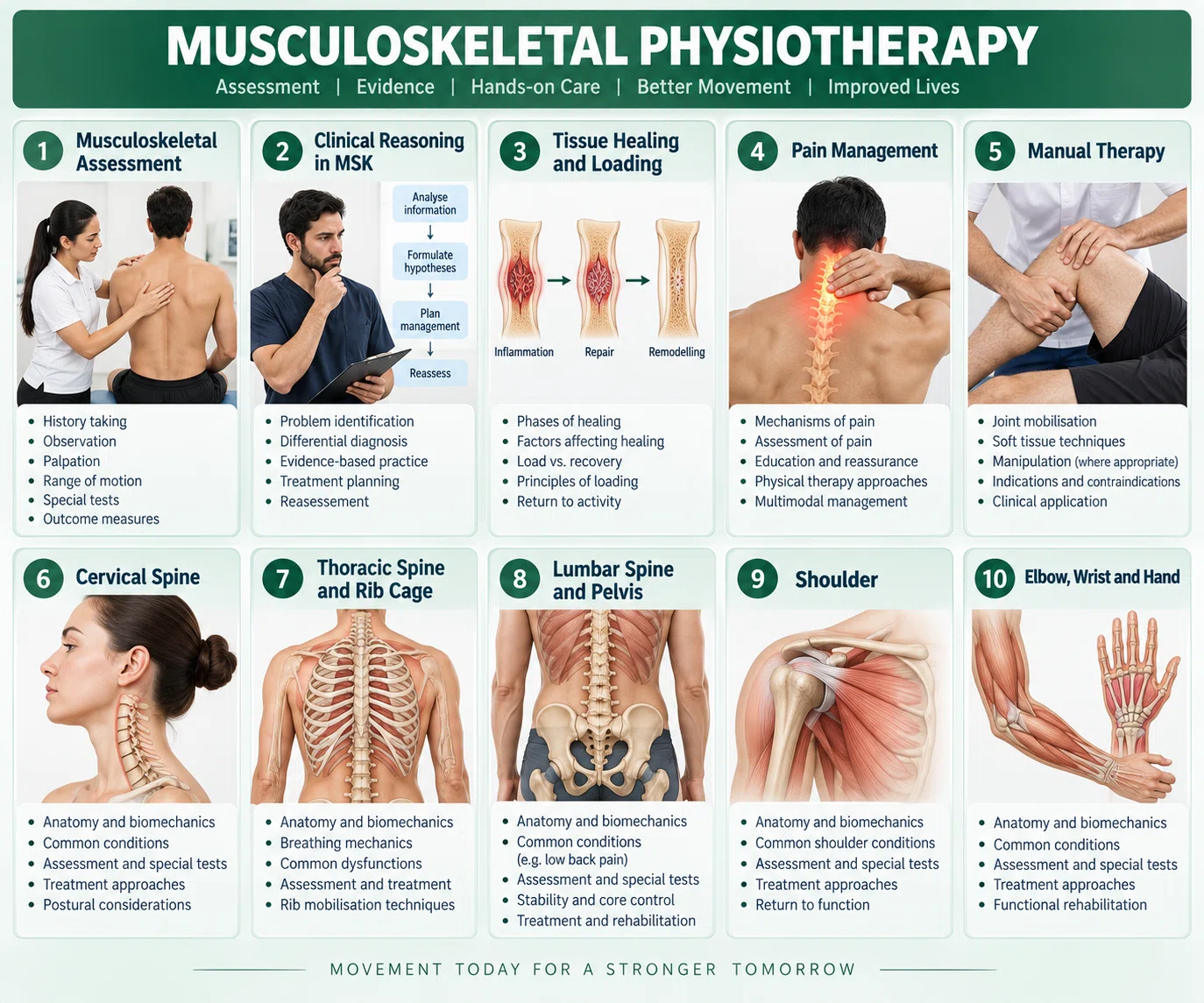
Musculoskeletal Physiotherapy
Subject Summary
The public overview below follows the supplied PhysioVeda Academics subject summary.
Musculoskeletal physiotherapy evaluates and manages disorders affecting muscles, tendons, ligaments, joints, bones, peripheral nerves and related movement systems. The emphasis is on restoring function, improving load tolerance and supporting confident participation in daily, occupational and recreational activity.
Assessment combines history, pain behavior, observation, palpation, range of motion, muscle testing, neurological screening, special tests and functional performance. No single test should be interpreted in isolation; findings are integrated with the clinical pattern and the need to screen for conditions requiring referral.
Modern management is active and progressive. Education, exercise, graded loading and functional retraining are central, while manual therapy, physical modalities, taping, bracing or assistive devices may be used selectively to support short-term goals.
Tissue healing and adaptation guide loading, but recovery is not determined by time alone. Symptoms, tissue irritability, function, strength, movement quality, psychological factors and response to progressive activity all influence rehabilitation decisions.
This summary follows the uploaded PhysioVeda Academics structure: assessment, clinical reasoning, tissue healing/loading, pain management, manual therapy, regional spine and limb rehabilitation, rheumatological rehabilitation and outcome measures.
Key numbers and exam points to remember
Use these supplied values and key facts for quick whole-subject revision.
| Item | Number / key fact |
|---|---|
| Manual muscle testing | Common ordinal scale: 0-5 |
| Pain intensity scales | Commonly 0-10 NRS or 0-100 mm VAS |
| Maitland mobilization grades | Grades I-IV; manipulation commonly taught separately as Grade V/HVLA thrust |
| ACL rehabilitation | Criteria-based; restore strength/control and use hop/functional testing for sport readiness |
| Tissue healing | 3 overlapping phases: inflammatory, proliferative and remodeling |
| Tendon loading | Progressive mechanical loading with adequate recovery |
| Outcome interpretation | Use reliability, validity, MDC and MCID when available |
| Red-flag principle | One finding rarely confirms serious pathology; interpret clusters and progression |
Core references
- Manske RC, Magee DJ. Magee's Orthopedic Physical Assessment. 8th ed. Elsevier; 2026.
- Kisner C, Borstad J, Colby LA. Therapeutic Exercise: Foundations and Techniques. 8th ed. F.A. Davis; 2023.
- Brukner P, Khan K, et al. Brukner & Khan's Clinical Sports Medicine: Managing Injuries. 6th ed. McGraw Hill; 2026.
- Heick J, Lazaro RT, eds. Goodman and Snyder's Differential Diagnosis for Physical Therapists: Screening for Referral. 7th ed. Elsevier; 2022.
- Neumann DA. Neumann's Kinesiology of the Musculoskeletal System: Foundations for Rehabilitation. 4th ed. Elsevier; 2024.
- Cifu DX, ed. Braddom's Physical Medicine and Rehabilitation. 7th ed. Elsevier; 2026.
- Fulk GD, Chui KK, eds. O'Sullivan & Schmitz's Physical Rehabilitation. 8th ed. F.A. Davis; 2024.
- Portney LG. Foundations of Clinical Research: Applications to Evidence-Based Practice. 4th ed. F.A. Davis; 2020.
Want to go deeper into Musculoskeletal Physiotherapy?
Continue into the complete topic and subtopic learning system with structured summaries, medical visuals, topic wise OBQ practice, timed tests, explanations and results.