

Rehabilitation Medicine
Study rehabilitation, recovery and functional independence.
General subject summary is free to everyone.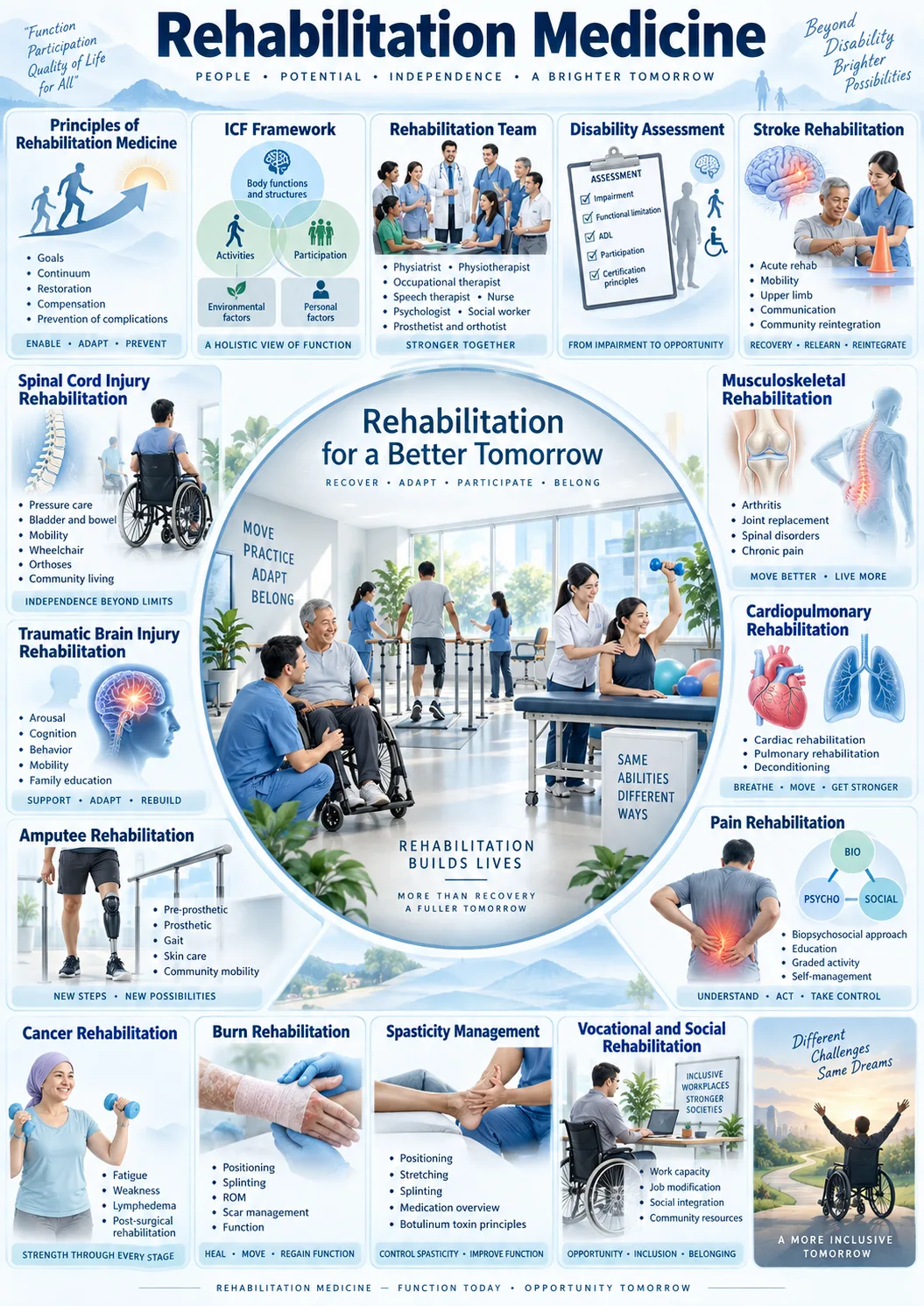
Rehabilitation Medicine
Subject Summary
The public overview below follows the supplied PhysioVeda Academics subject summary.
Rehabilitation medicine focuses on optimizing functioning, independence, participation and quality of life after illness, injury or disability rather than treating disease alone.
Modern rehabilitation uses a biopsychosocial model. A diagnosis is important, but management also considers impairments, activity limitations, participation restrictions, environmental barriers, personal goals and available supports.
The rehabilitation continuum extends from acute medical care through inpatient or outpatient rehabilitation, community reintegration, long-term self-management and prevention of secondary complications.
Restorative strategies aim to recover lost function; compensatory strategies use alternative methods, assistive technology, orthoses, prostheses, environmental modification or caregiver support when complete restoration is not possible.
This summary covers principles, ICF, team roles, disability assessment, stroke, spinal cord injury, traumatic brain injury, amputee rehabilitation, musculoskeletal and cardiopulmonary rehabilitation, pain, cancer, burns, spasticity and vocational/social rehabilitation.
Whole-subject high-yield numbers
Use these supplied values and key facts for quick whole-subject revision.
| Item | Number / key fact |
|---|---|
| ICF contextual components | Environmental factors + personal factors |
| Major ICF functioning domains used clinically | Body functions/structures, activities, participation |
| ASIA Impairment Scale | 5 grades: A-E |
| Neurological SCI motor key muscles | 10 key muscle groups tested bilaterally in ISNCSCI |
| Cranial Glasgow Coma Scale total | 3-15 |
| Rancho Los Amigos cognitive levels | 10 levels in the revised scale |
| Classic Brunnstrom stroke motor-recovery stages | 6 stages |
| Major lower-limb prosthetic amputation categories | Transtibial and transfemoral are the common major levels |
| Cardiac rehabilitation phases | Often taught as Phase I-IV continuum; naming varies |
| Burn positioning principle | Oppose the direction of expected contracture |
| Modified Ashworth Scale | 0, 1, 1+, 2, 3, 4 |
| Common vocational sequence | Assess capacity -> modify job -> graded return -> sustain participation |
Core textbook and framework references used throughout
- Cifu DX, ed. Braddom's Physical Medicine and Rehabilitation. 7th ed. Elsevier; 2026.
- Frontera WR, DeLisa JA, et al., eds. DeLisa's Physical Medicine and Rehabilitation: Principles and Practice. 6th ed. Wolters Kluwer; 2020.
- Fulk GD, Chui KK, eds. O'Sullivan & Schmitz's Physical Rehabilitation. 8th ed. F.A. Davis; 2024.
- World Health Organization. International Classification of Functioning, Disability and Health (ICF). WHO; current online release.
- Kisner C, Borstad J, Colby LA. Therapeutic Exercise: Foundations and Techniques. 8th ed. F.A. Davis; 2023.
Want to go deeper into Rehabilitation Medicine?
Continue into the complete topic and subtopic learning system with structured summaries, medical visuals, topic wise OBQ practice, timed tests, explanations and results.