

Pharmacology
Understand drug actions, therapeutic uses, adverse effects and clinically important precautions.
General subject summary is free to everyone.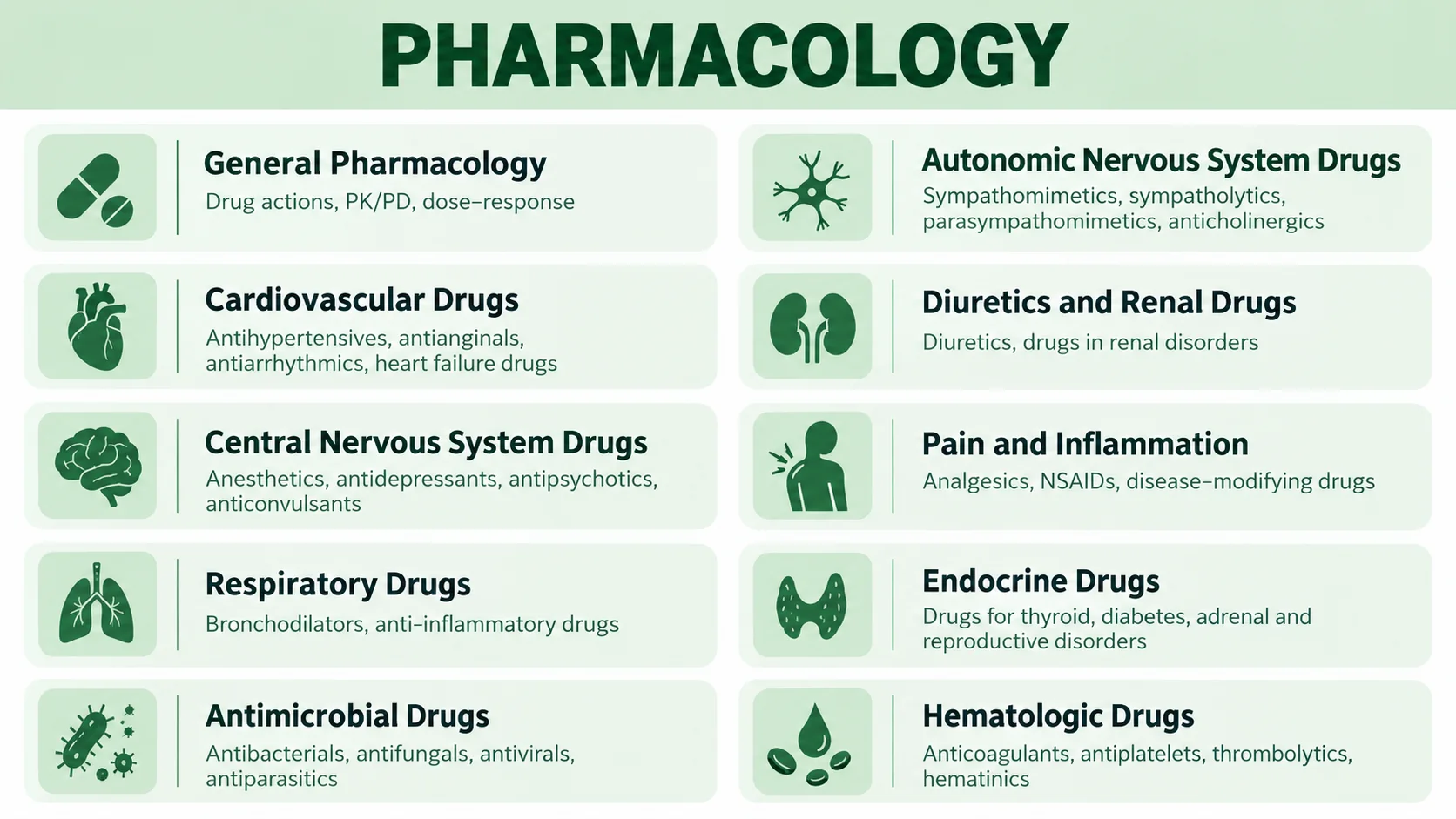
Pharmacology
Subject Summary
The public overview below follows the supplied PhysioVeda Academics subject summary.
Pharmacology is the study of drugs and their interactions with living systems, including how drugs are absorbed, distributed, metabolized and excreted, how they act at molecular targets, and how benefits are balanced against adverse effects.
For physiotherapy and rehabilitation, pharmacology is clinically important because medicines can alter heart rate, blood pressure, alertness, balance, pain, muscle tone, bleeding risk, exercise tolerance, glucose control and respiratory function.
A useful pharmacology framework links each drug class to mechanism of action, major clinical uses, important adverse effects, clinically relevant interactions and monitoring considerations rather than memorizing isolated drug names.
Drug response varies with age, renal and hepatic function, genetics, comorbidity, pregnancy, concurrent medicines and adherence. Safe care therefore depends on medication history and recognition of effects that can influence examination or exercise.
This summary follows the uploaded PhysioVeda Academics structure: general pharmacology, autonomic drugs, cardiovascular and renal drugs, CNS agents, pain and inflammation, respiratory/endocrine/antimicrobial/hematologic/GI drugs, and toxicology/emergency pharmacology.
Whole-subject high-yield numbers
Use these supplied values and key facts for quick whole-subject revision.
| Intravenous bioavailability | 100% by definition |
| Typical time to near steady state | About 4-5 elimination half-lives for many drugs with first-order kinetics |
| Half-life relationship | t1/2 = 0.693 x Vd / clearance |
| Therapeutic index | Classically TD50 / ED50; larger value generally indicates a wider safety margin |
| Major receptor superfamilies | Ligand-gated ion channels, GPCRs, enzyme-linked receptors, intracellular/nuclear receptors |
| First-order elimination | A constant fraction of drug is eliminated per unit time |
| Zero-order elimination | A constant amount is eliminated per unit time when elimination pathways are saturated |
| Autonomic postganglionic transmitter | Parasympathetic: ACh; most sympathetic: norepinephrine |
| Adrenergic beta receptors | Beta1, beta2 and beta3 |
| Steady-state clinical principle | Loading dose affects time to target concentration; maintenance dose replaces eliminated drug |
Core references
- Vanderah TW, ed. Katzung's Basic & Clinical Pharmacology. 16th ed. McGraw Hill; 2024.
- Ritter JM, Flower RJ, Henderson G, et al. Rang & Dale's Pharmacology. 10th ed. Elsevier; 2023.
- Brunton LL, Hilal-Dandan R, Knollmann BC, eds. Goodman & Gilman's The Pharmacological Basis of Therapeutics. 14th ed. McGraw Hill; 2022.
- Whalen K. Lippincott Illustrated Reviews: Pharmacology. 8th ed. Wolters Kluwer; 2022.
Want to go deeper into Pharmacology?
Continue into the complete topic and subtopic learning system with structured summaries, medical visuals, topic wise OBQ practice, timed tests, explanations and results.