

Clinical Examination & Assessment
Clinical examination and assessment is the structured process of collecting history, observing the patient, measuring body functions, testing movement and neurological status, evaluating function, and integrating findings into a clinical impression and treatment plan.
General subject summary is free to everyone.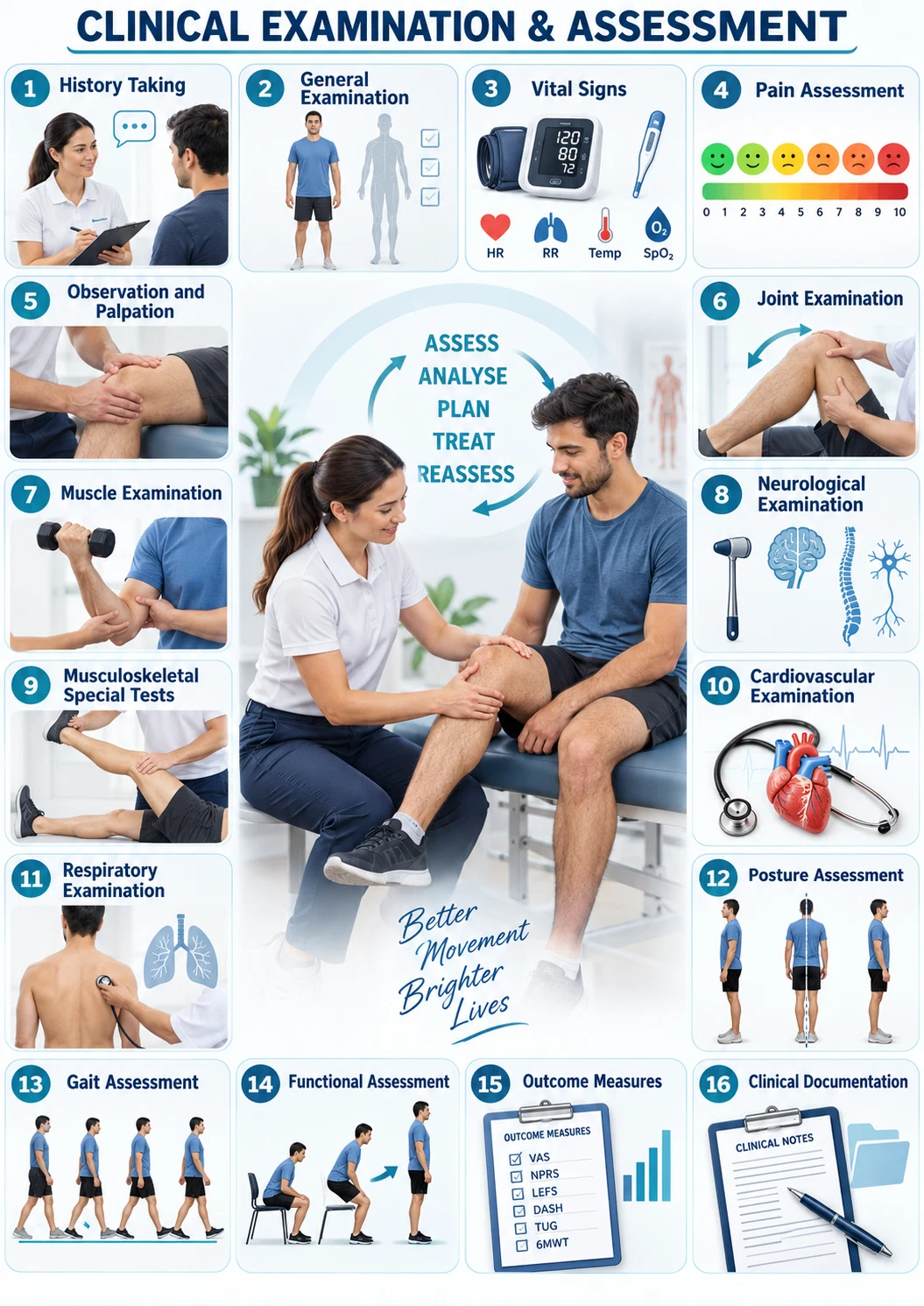
Clinical Examination & Assessment
Subject Summary
The public overview below follows the supplied PhysioVeda Academics subject summary.
Clinical examination and assessment is the structured process of collecting history, observing the patient, measuring body functions, testing movement and neurological status, evaluating function, and integrating findings into a clinical impression and treatment plan.
A good assessment moves from broad safety screening to focused examination. It first identifies red flags or medical instability, then examines the impairments and activities most relevant to the patient's chief problem.
Findings should be interpreted as patterns rather than isolated numbers. A special test, muscle grade, pain score or posture finding rarely establishes a diagnosis on its own.
Repeated measurement is central to rehabilitation because reassessment shows whether the patient is improving, whether the original hypothesis remains reasonable, and whether the treatment plan should change.
This summary covers history taking, general examination, vital signs, pain, observation/palpation, joint and muscle examination, neurological and musculoskeletal testing, cardiovascular and respiratory assessment, posture, gait, functional assessment, outcome measures and clinical documentation.
Whole-subject high-yield numbers
Use these supplied values and key facts for quick whole-subject revision.
| Item | Number / key fact |
|---|---|
| Cranial nerves | 12 pairs |
| Manual muscle testing | Common ordinal scale: 0-5 |
| Deep tendon reflex grading | Common clinical scale: 0 to 4+ |
| Numeric pain rating scale | 0-10 |
| Visual analogue scale | Commonly 100 mm line |
| Typical resting adult pulse | About 60-100 beats/min; context dependent |
| Typical resting adult respiratory rate | About 12-20 breaths/min |
| Typical healthy adult SpO2 at sea level | Often about 95-100%; interpret with context |
| Gait cycle | Stance ~60%; swing ~40% at comfortable walking speed |
| Perry gait phases | 8 phases |
| SOAP documentation | Subjective, Objective, Assessment, Plan |
| Core measurement properties | Reliability + validity + responsiveness/measurement error |
Core references
- Soriano RP. Bates' Guide to Physical Examination and History Taking. 14th ed. Wolters Kluwer; 2025.
- Manske RC, Magee DJ. Magee's Orthopedic Physical Assessment. 8th ed. Elsevier; 2026.
- Avers D, Lott DJ, Brown M. Daniels and Worthingham's Muscle Testing: Techniques of Manual Muscle and Physical Performance Testing. 11th ed. Elsevier; 2024.
- Fulk GD, Chui KK, eds. O'Sullivan & Schmitz's Physical Rehabilitation. 8th ed. F.A. Davis; 2024.
- Reese NB, Bandy WD. Joint Range of Motion and Muscle Length Testing. 4th ed. Elsevier; 2024.
- American College of Sports Medicine. ACSM's Guidelines for Exercise Testing and Prescription. 12th ed. Wolters Kluwer; 2025.
- Portney LG. Foundations of Clinical Research: Applications to Evidence-Based Practice. 4th ed. F.A. Davis; 2020.
- Perry J, Burnfield JM. Gait Analysis: Normal and Pathological Function. 2nd ed. SLACK/CRC Press; 2010.
Want to go deeper into Clinical Examination & Assessment?
Continue into the complete topic and subtopic learning system with structured summaries, medical visuals, topic wise OBQ practice, timed tests, explanations and results.