

Embryology
Embryology is the study of human development from formation of the gametes through fertilization, implantation, organogenesis, fetal growth and birth.
General subject summary is free to everyone.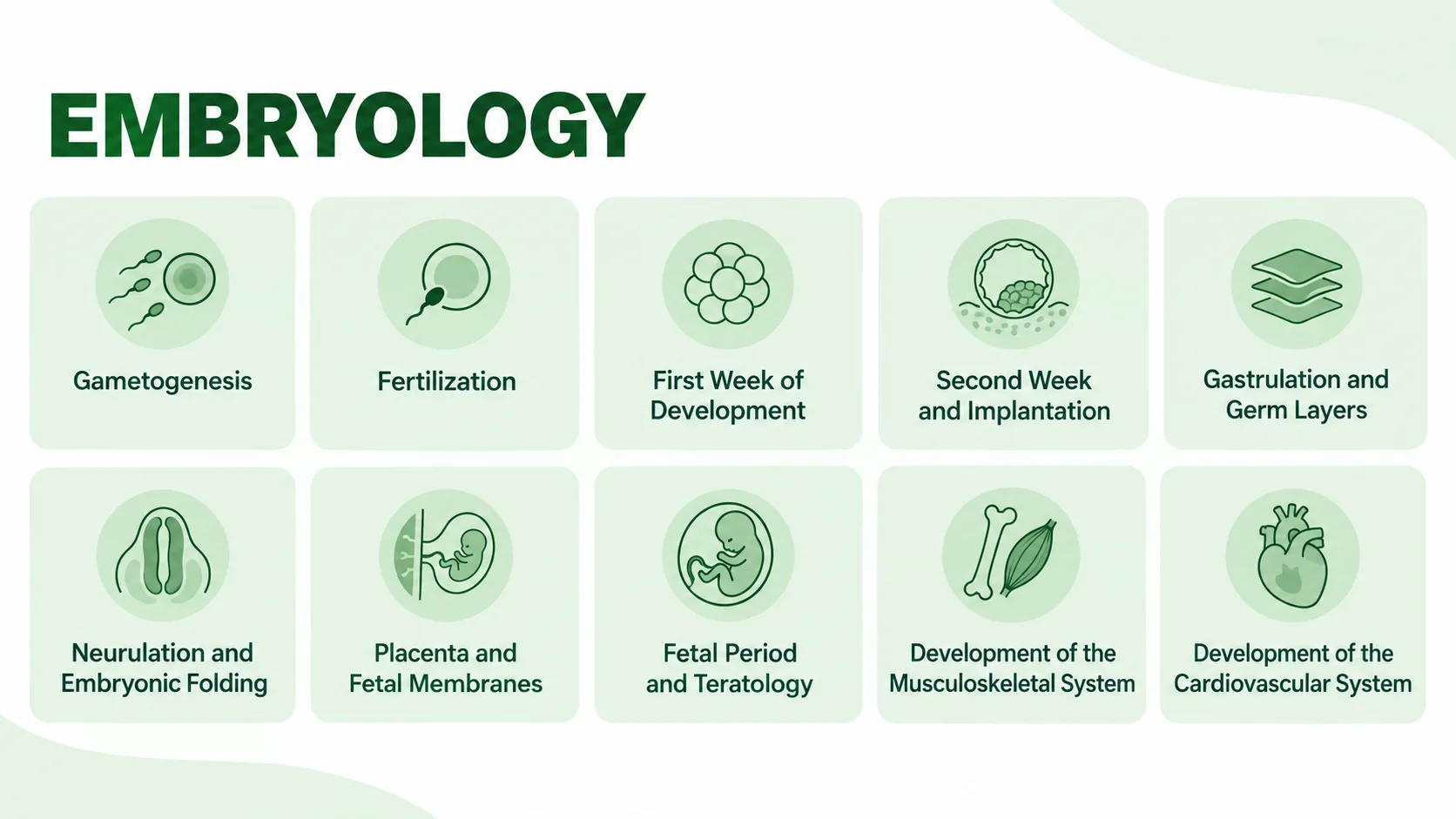
Embryology
Subject Summary
The public overview below follows the supplied PhysioVeda Academics subject summary.
Embryology is the study of human development from formation of the gametes through fertilization, implantation, organogenesis, fetal growth and birth.
A useful clinical framework is chronological: gametogenesis and fertilization are followed by cleavage and implantation, gastrulation establishes the three germ layers, neurulation and folding shape the embryo, and organ systems then differentiate from defined embryonic tissues.
The embryonic period is the time of major organ formation and therefore the period of greatest vulnerability to many teratogens; the fetal period is dominated by growth and functional maturation.
For physiotherapy and medical sciences, embryology explains congenital anomalies of the nervous, musculoskeletal, cardiovascular and other systems and supports understanding of prenatal diagnosis and prevention.
This summary follows the uploaded PhysioVeda Academics structure from Gametogenesis through Congenital Anomalies and Prenatal Diagnosis.
Whole-subject high-yield numbers
Use these supplied values and key facts for quick whole-subject revision.
| Human gestation | About 38 weeks from fertilization; about 40 weeks from last menstrual period |
| Fertilization | Usually occurs in the ampulla of the uterine tube |
| Cleavage | Rapid mitotic divisions without overall growth of the conceptus |
| Morula | About 16-cell stage, around day 3 |
| Blastocyst | Forms by about day 4-5; implantation begins around day 6-7 |
| Gastrulation | Begins in week 3 and establishes ectoderm, mesoderm and endoderm |
| Neural tube closure | Cranial and caudal neuropores close during week 4 |
| Embryonic period | Weeks 3-8; major organogenesis |
| Fetal period | Week 9 to birth; growth and maturation |
| Placental exchange | Maternal and fetal blood normally do not directly mix |
Core references
- Sadler TW. Langman's Medical Embryology. 15th ed. Wolters Kluwer.
- Moore KL, Persaud TVN, Torchia MG. The Developing Human: Clinically Oriented Embryology. 12th ed. Elsevier.
- Schoenwolf GC, Bleyl SB, Brauer PR, Francis-West PH. Larsen's Human Embryology. 6th ed. Elsevier.
Want to go deeper into Embryology?
Continue into the complete topic and subtopic learning system with structured summaries, medical visuals, topic wise OBQ practice, timed tests, explanations and results.