

Medicine
Recognize common adult medical disorders, clinical warning signs and rehabilitation considerations.
General subject summary is free to everyone.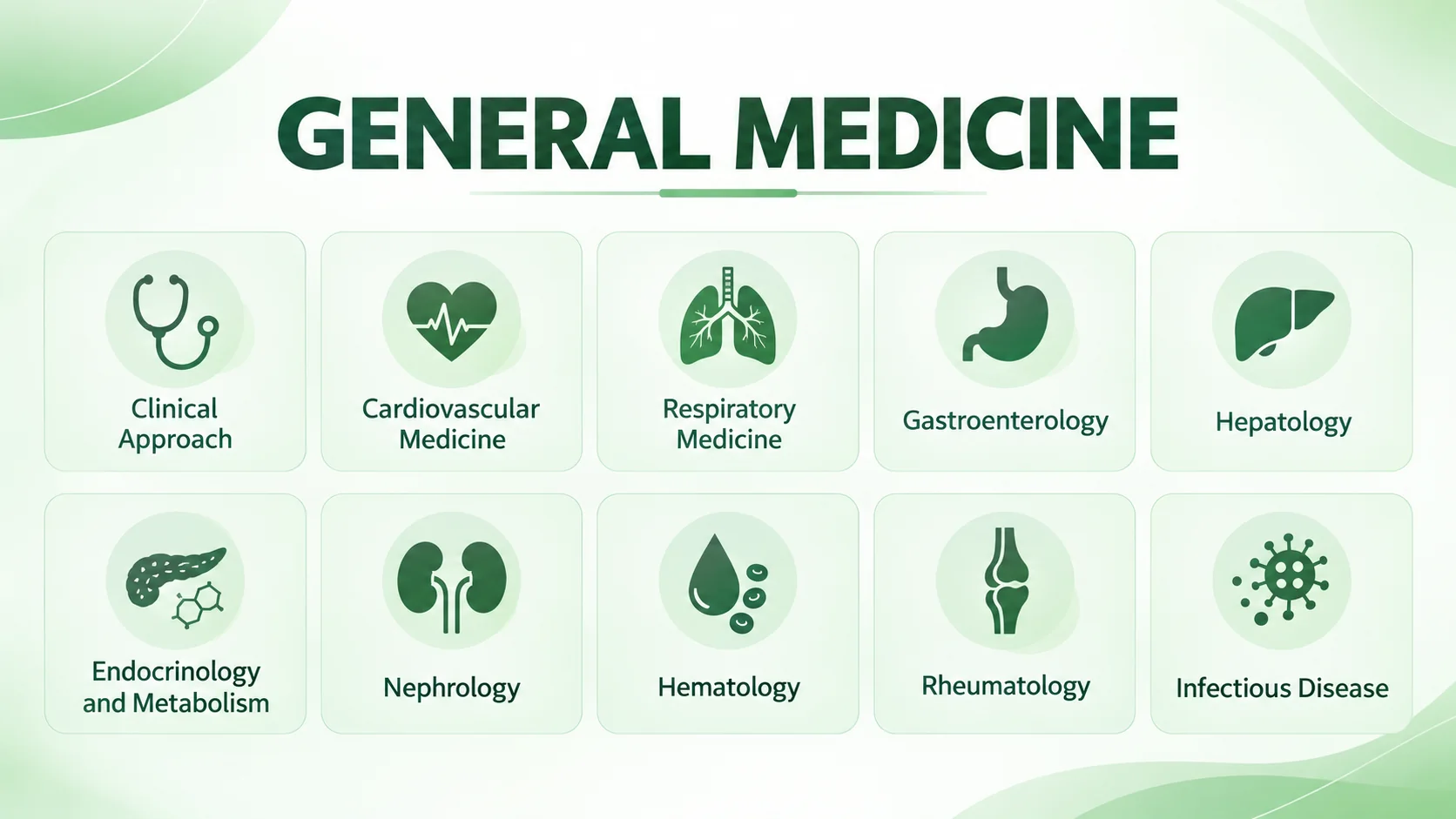
Medicine
Subject Summary
The public overview below follows the supplied PhysioVeda Academics subject summary.
General medicine integrates clinical history, physical examination, investigations and pathophysiology to recognize, diagnose and manage common adult medical disorders across multiple organ systems.
For physiotherapy and rehabilitation, medical knowledge is essential because cardiovascular, respiratory, metabolic, renal, hematologic, neurological and psychiatric disease can alter exercise tolerance, mobility, cognition, healing and treatment safety.
A practical medical approach begins with the presenting problem and severity, identifies red flags and instability, establishes a working diagnosis, confirms or refines it with targeted investigations, and repeatedly reassesses response to treatment.
Many common conditions are chronic and multisystem. Rehabilitation therefore requires awareness of comorbidity, medication effects, frailty, infection risk, oxygenation, glucose control, fluid balance and the patient's functional goals.
This summary follows the uploaded PhysioVeda Academics structure: clinical approach, cardiovascular, respiratory, gastrointestinal, liver, endocrine/metabolic, renal, hematologic, rheumatologic, infectious, neurological, dermatologic and psychiatric medicine, followed by medical emergencies.
Whole-subject high-yield numbers
Use these supplied values and key facts for quick whole-subject revision.
| Normal adult resting pulse | Usually 60-100 beats/min; athletic and clinical variation occurs |
| Normal adult respiratory rate | Usually about 12-20 breaths/min at rest |
| Normal arterial oxygen saturation | Often about 95-100% at sea level in healthy adults; lower targets may be prescribed in selected disease |
| Normal body temperature | Approximately 36.5-37.5 C depending on site and time |
| Diabetes diagnostic fasting plasma glucose | ≥126 mg/dL (7.0 mmol/L) on appropriate testing/confirmation |
| Severe hypoglycemia principle | Altered consciousness or inability to self-treat requires urgent assistance |
| CKD definition | Abnormal kidney structure/function persisting greater than 3 months |
| Anemia concept | Hemoglobin below the reference range for age/sex; exact cutoffs vary by guideline/lab |
| Glasgow Coma Scale | 3-15 |
| Shock principle | Inadequate tissue perfusion/oxygen delivery; medical emergency |
Core references
- Strachan MWJ, Ralston SH, Dhaun N, Sutherland R, eds. Davidson's Principles and Practice of Medicine. 25th ed. Elsevier; 2026.
- Loscalzo J, Fauci AS, Kasper DL, et al., eds. Harrison's Principles of Internal Medicine. 22nd ed. McGraw Hill; 2025.
- Randall D, Booth J, Wiles K, eds. Kumar and Clark's Clinical Medicine. 11th ed. Elsevier; 2025.
- Dover AR, Innes JA, Fairhurst K, eds. Macleod's Clinical Examination. 15th ed. Elsevier; 2023.
Want to go deeper into Medicine?
Continue into the complete topic and subtopic learning system with structured summaries, medical visuals, topic wise OBQ practice, timed tests, explanations and results.