
Immunology
Immunology is the study of host defense, immune recognition and the coordinated cellular and molecular responses that protect against infection while maintaining tolerance to self.
General subject summary is free to everyone.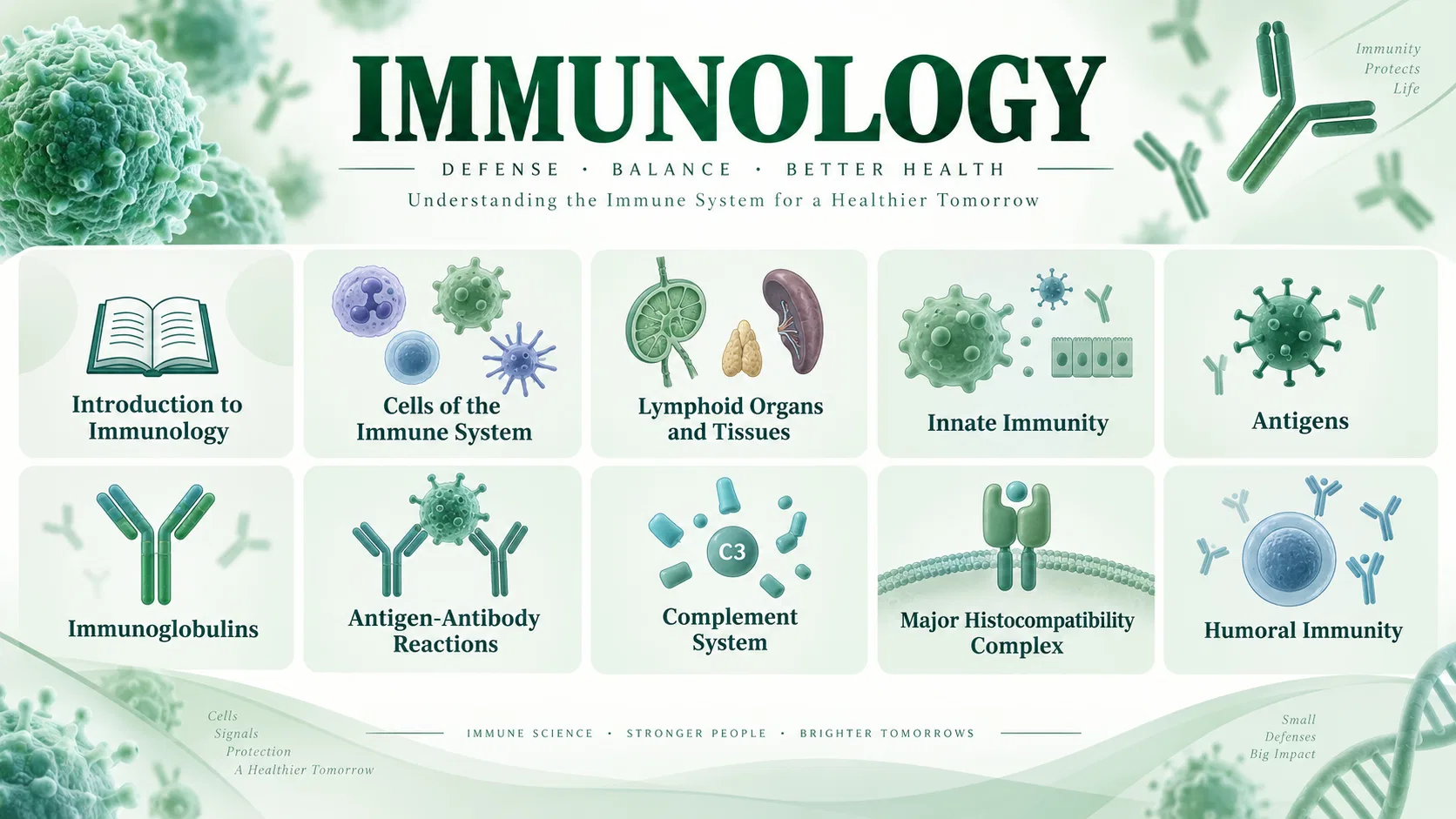
Immunology
Subject Summary
The public overview below follows the supplied PhysioVeda Academics subject summary.
Immunology is the study of host defense, immune recognition and the coordinated cellular and molecular responses that protect against infection while maintaining tolerance to self.
Innate immunity provides rapid pattern-based defense, whereas adaptive immunity uses antigen-specific B- and T-cell receptors, clonal expansion and immunologic memory.
Antibodies, complement, cytokines, antigen presentation and lymphoid organs link the major arms of immunity, while dysregulation can produce allergy, autoimmunity, immunodeficiency or transplant rejection.
Clinical immunology also underpins vaccination, laboratory immunoassays, monoclonal antibody therapy, checkpoint inhibition and other modern immunotherapies.
This summary follows the uploaded PhysioVeda Academics structure from introduction and immune cells through vaccines and tumor immunology.
Whole-subject high-yield numbers
Use these supplied values and key facts for quick whole-subject revision.
| Innate immunity | Rapid; germline-encoded pattern recognition; no classical antigen-specific memory |
| Adaptive immunity | Antigen specific; clonal expansion; memory |
| Primary lymphoid organs | Bone marrow and thymus |
| Major antibody classes | IgG, IgM, IgA, IgE, IgD |
| MHC class I | Presents mainly endogenous peptides to CD8 T cells |
| MHC class II | Presents mainly exogenous peptides to CD4 T cells |
| Complement terminal complex | C5b-9 membrane attack complex |
| Hypersensitivity | Types I, II, III and IV |
| Primary immune response | Slower; IgM appears first, followed by class-switched responses |
| Secondary immune response | Faster, larger and higher-affinity because of memory cells |
Core references
- Abbas AK, Lichtman AH, Pillai S. Cellular and Molecular Immunology. 11th ed. Elsevier.
- Murphy K, Weaver C, Berg LJ. Janeway's Immunobiology. 10th ed. W.W. Norton/Garland Science.
- Abbas AK, Lichtman AH, Pillai S. Basic Immunology: Functions and Disorders of the Immune System. 7th ed. Elsevier.
Want to go deeper into Immunology?
Continue into the complete topic and subtopic learning system with structured summaries, medical visuals, topic wise OBQ practice, timed tests, explanations and results.