

Clinical Reasoning & Decision Making
Clinical reasoning is the thinking and decision-making process used to understand a patient problem, identify important findings, generate and test hypotheses, estimate prognosis, select management and judge the response to care.
General subject summary is free to everyone.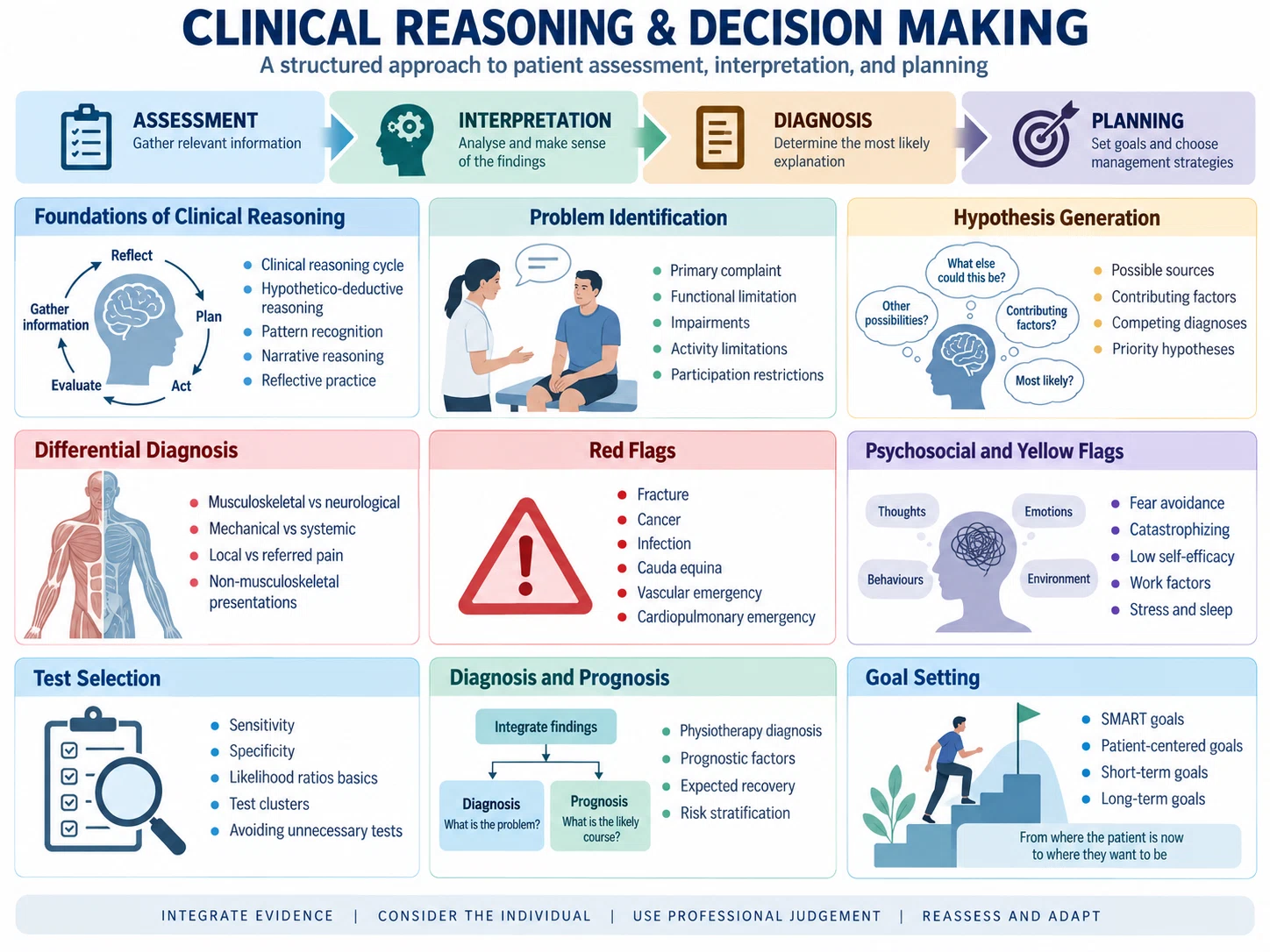
Clinical Reasoning & Decision Making
Subject Summary
The public overview below follows the supplied PhysioVeda Academics subject summary.
Clinical reasoning is the thinking and decision-making process used to understand a patient problem, identify important findings, generate and test hypotheses, estimate prognosis, select management and judge the response to care.
Reasoning is iterative rather than linear. New information from history, examination, treatment response, outcome measures or changing symptoms may strengthen one hypothesis, weaken another or create a need for referral.
Skilled reasoning integrates pattern recognition with deliberate analytical thinking. Pattern recognition is efficient when the presentation is familiar, while hypothetico-deductive reasoning is especially important when findings are incomplete, atypical or potentially serious.
Patient goals, values, psychosocial context, environment and resources are part of the decision, not additions after the diagnosis. The ICF framework helps connect impairments with activity limitations, participation restrictions and contextual factors.
Safety is a core reasoning task. Physiotherapists screen for red flags and non-musculoskeletal presentations, recognize when uncertainty is too high for routine management, and refer or escalate when the expected benefit of further medical evaluation outweighs the risk of delay.
This summary covers foundations, problem identification, hypothesis generation, differential diagnosis, red and yellow flags, diagnostic test interpretation, prognosis, goal setting, intervention dosage, reassessment, evidence integration, referral and case-based reasoning.
Whole-subject high-yield numbers
Use these supplied values and key facts for quick whole-subject revision.
| Item | Number / key fact |
|---|---|
| Core evidence-based practice elements | Research evidence + clinical expertise + patient values/preferences; applied within context/resources |
| ICF clinical domains | Body functions/structures, activities, participation + contextual factors |
| SMART goal elements | 5: Specific, Measurable, Achievable, Relevant, Time-bound |
| Sensitivity | TP / (TP + FN) |
| Specificity | TN / (TN + FP) |
| Positive likelihood ratio (LR+) | Sensitivity / (1 - specificity) |
| Negative likelihood ratio (LR-) | (1 - sensitivity) / specificity |
| Large diagnostic shift - common teaching guide | LR+ >10 or LR- <0.1; not absolute rules |
| FITT-VP dosage framework | Frequency, Intensity, Time, Type, Volume, Progression |
| Core reassessment question | Better, worse or unchanged - and is the change clinically meaningful? |
| Red-flag principle | A cluster/context changes concern more than one isolated sign |
| Safety-net principle | Explain expected course + warning signs + what action to take if they occur |
Core references
- Higgs J, Jensen GM, Loftus S, Trede F, Grace S, eds. Clinical Reasoning in the Health Professions. 5th ed. Elsevier; 2025.
- Heick J, Lazaro RT, eds. Goodman and Snyder's Differential Diagnosis for Physical Therapists: Screening for Referral. 7th ed. Elsevier; 2022.
- Jones MA, Rivett DA, eds. Clinical Reasoning for Manual Therapists. Butterworth-Heinemann; 2004.
- Jewell DV. Guide to Evidence-Based Physical Therapist Practice. 5th ed. Jones & Bartlett Learning; 2023.
- American Physical Therapy Association. Guide to Physical Therapist Practice 4.0. APTA; current online edition.
- World Health Organization. International Classification of Functioning, Disability and Health (ICF). WHO; current online release.
- Manske RC, Magee DJ. Magee's Orthopedic Physical Assessment. 8th ed. Elsevier; 2026.
- Kisner C, Borstad J, Colby LA. Therapeutic Exercise: Foundations and Techniques. 8th ed. F.A. Davis; 2023.
Want to go deeper into Clinical Reasoning & Decision Making?
Continue into the complete topic and subtopic learning system with structured summaries, medical visuals, topic wise OBQ practice, timed tests, explanations and results.