

Basic Life Support and CPR
Basic Life Support (BLS) is the immediate recognition and treatment of cardiac arrest, respiratory arrest and severe airway obstruction until advanced care is available.
General subject summary is free to everyone.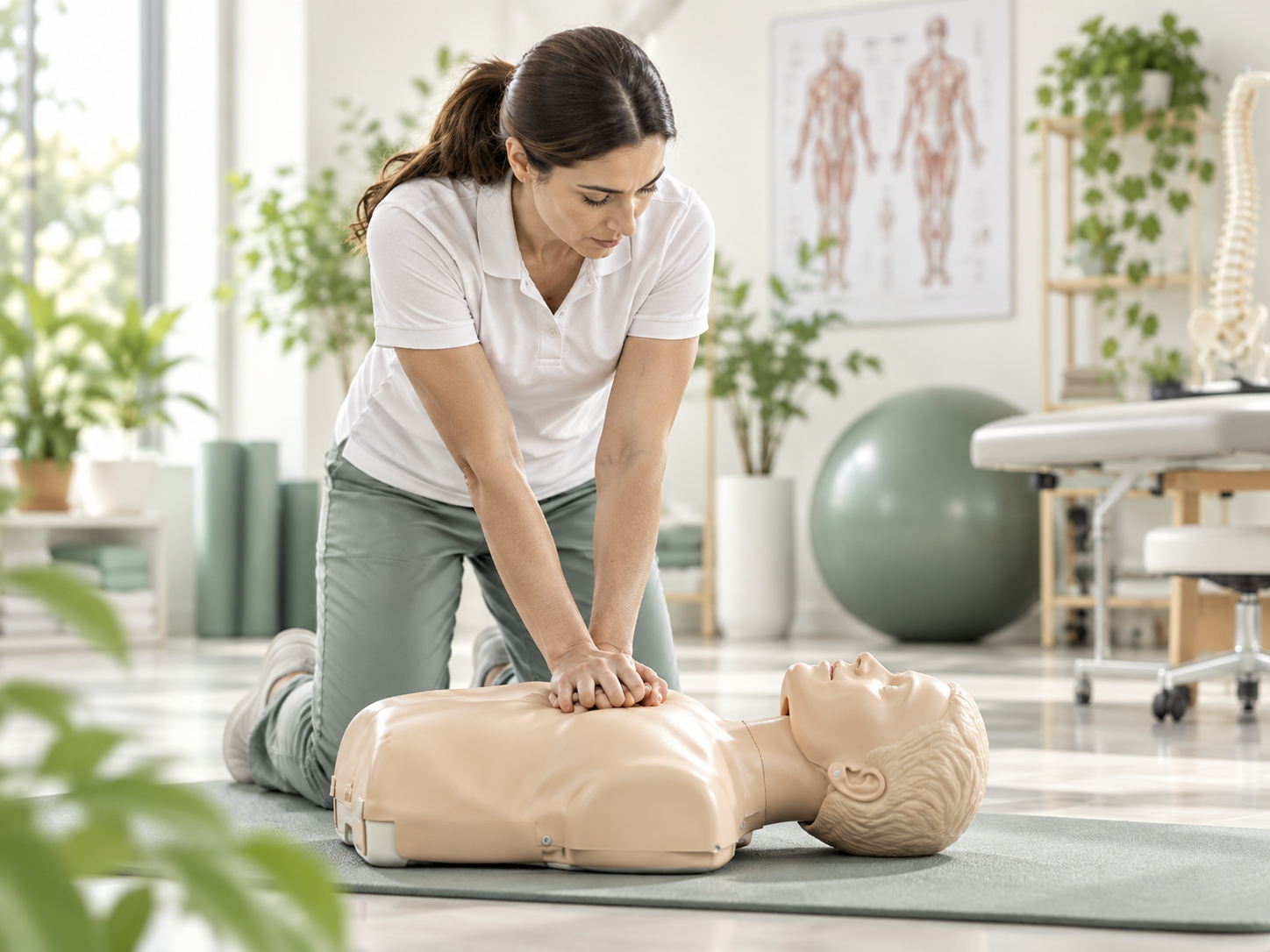
Basic Life Support and CPR
Subject Summary
The public overview below follows the supplied PhysioVeda Academics subject summary.
Basic Life Support (BLS) is the immediate recognition and treatment of cardiac arrest, respiratory arrest and severe airway obstruction until advanced care is available.
The core sequence is early recognition, activation of the emergency response system, high-quality cardiopulmonary resuscitation, rapid use of an automated external defibrillator and coordinated transfer to advanced resuscitation and post-arrest care.
High-quality CPR requires an adequate compression rate and depth, full chest recoil, minimal interruptions and ventilation that produces visible chest rise without excessive breaths.
Pediatric BLS emphasizes ventilation because respiratory failure and asphyxia are common causes of arrest in children and infants, while adult sudden arrest is commonly cardiac in origin.
This summary follows the uploaded PhysioVeda Academics structure from BLS foundations and the Chain of Survival through adult, child and infant CPR, AED use, choking, special situations, teamwork, infection prevention, documentation and competency.
Whole-subject high-yield numbers
Use these supplied values and key facts for quick whole-subject revision.
| Adult compression rate | 100-120/min |
| Adult depth | 5-6 cm |
| Adult single/two-rescuer ratio | 30:2 before advanced airway |
| Child depth | At least 1/3 AP chest depth, about 5 cm |
| Infant depth | At least 1/3 AP chest depth, about 4 cm |
| Single-rescuer child/infant ratio | 30:2 |
| Two-rescuer child/infant ratio | 15:2 |
| Pulse check for trained responder | No more than 10 seconds |
| AED | Apply as soon as available; resume CPR immediately after shock/no-shock prompt |
| Compression fraction | Minimize pauses; aim for the greatest feasible time compressing |
Core references
- American Heart Association. Basic Life Support Provider Manual. American Heart Association; 2025.
- Walls RM, Hockberger RS, Gausche-Hill M, eds. Rosen's Emergency Medicine: Concepts and Clinical Practice. 10th ed. Elsevier; 2023.
- Tintinalli JE, Ma OJ, Yealy DM, et al., eds. Tintinalli's Emergency Medicine: A Comprehensive Study Guide. 10th ed. McGraw Hill; 2024.
Want to go deeper into Basic Life Support and CPR?
Continue into the complete topic and subtopic learning system with structured summaries, medical visuals, topic wise OBQ practice, timed tests, explanations and results.