

Electrotherapy
Electrotherapy is the therapeutic use of electrical currents, electromagnetic energy, sound energy, light, heat, cold and mechanical agents to influence pain, muscle activity, tissue temperature, circulation, mobility and functional rehabilitation.
General subject summary is free to everyone.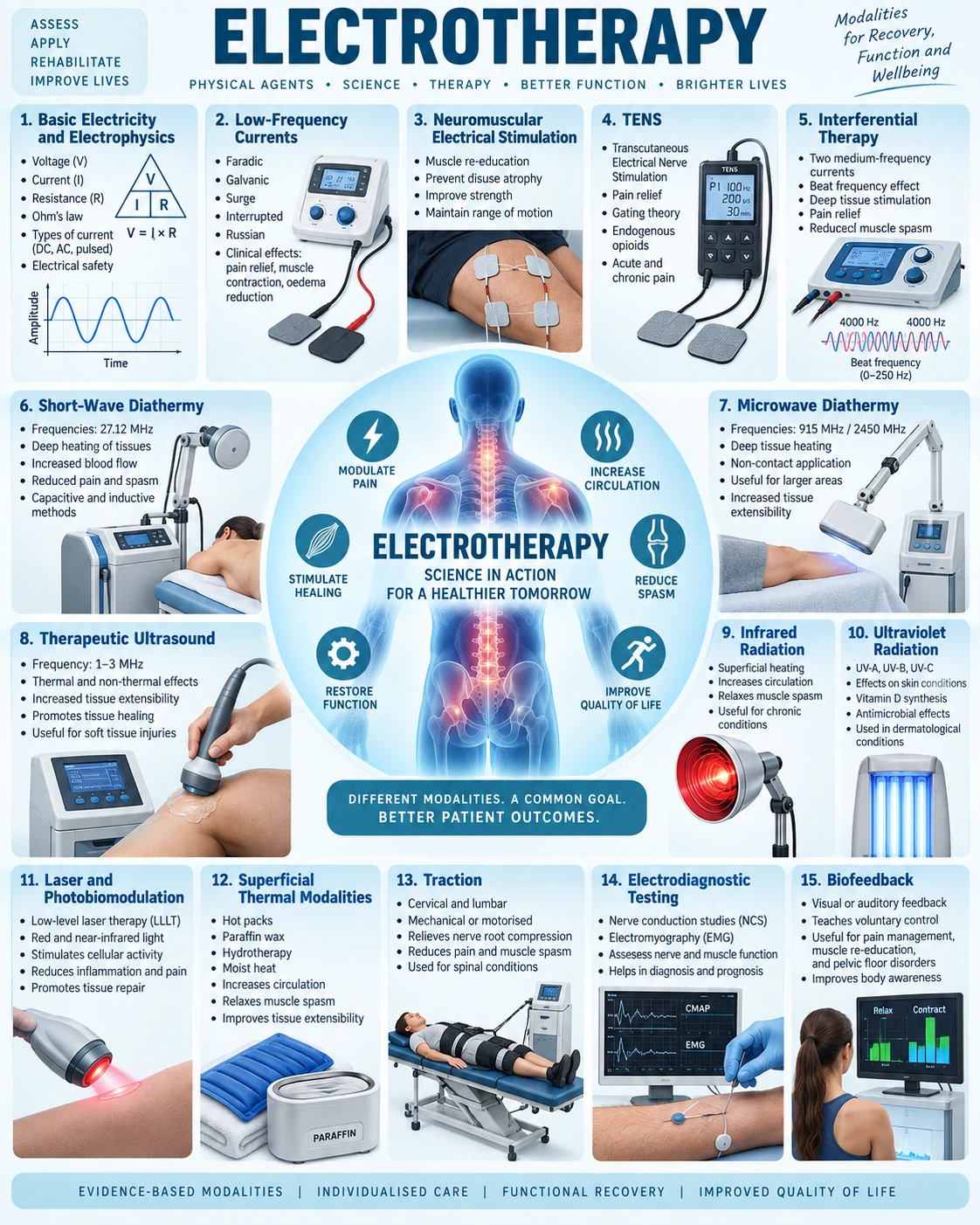
Electrotherapy
Subject Summary
The public overview below follows the supplied PhysioVeda Academics subject summary.
Electrotherapy is the therapeutic use of electrical currents, electromagnetic energy, sound energy, light, heat, cold and mechanical agents to influence pain, muscle activity, tissue temperature, circulation, mobility and functional rehabilitation.
Safe practice begins with understanding the physical agent: waveform or frequency, intensity, pulse duration, duty cycle, electrode or applicator placement, treatment time and the way energy is transferred into tissue.
Electrophysical agents are adjuncts to rehabilitation rather than stand-alone treatments. Their value depends on a clear clinical goal, appropriate patient selection, correct dosage, monitoring and integration with exercise or functional retraining.
Parameters are not universal prescriptions. Tissue depth, sensation, circulation, implanted devices, pregnancy, malignancy, wound status, cognition and treatment location can change whether a modality is appropriate and how it should be applied.
This summary covers basic electrophysics, low-frequency currents, NMES/FES, TENS, interferential therapy, diathermy, ultrasound, infrared, ultraviolet, photobiomodulation, superficial thermal agents, traction, electrodiagnostic testing and EMG biofeedback.
Whole-subject high-yield numbers
Use these supplied values and key facts for quick whole-subject revision.
| Item | Number / key fact |
|---|---|
| Ohm's law | V = I x R |
| Electrical power | P = V x I; 1 watt = 1 joule/second |
| Conventional TENS | Commonly ~50-150 Hz with short pulses, often ~50-100 microseconds |
| Acupuncture-like TENS | Commonly ~1-10 Hz with longer pulses and strong motor-level intensity |
| Interferential carrier frequency | Classically around 4 kHz; beat frequency equals difference between the two currents |
| Short-wave diathermy | 27.12 MHz is the most commonly taught clinical carrier frequency |
| Microwave diathermy | 2450 MHz is a commonly used clinical frequency |
| Therapeutic ultrasound | 1 MHz for deeper tissues; 3 MHz for more superficial tissues |
| Ultraviolet bands | UVA 315-400 nm; UVB 280-315 nm; UVC 100-280 nm |
| Photobiomodulation dose | Energy (J) = power (W) x time (s); dose often expressed as J/cm2 |
| Hydrocollator hot-pack tank | Commonly maintained around 70-75 C |
| Rheobase / chronaxie | Rheobase = minimum long-duration current; chronaxie = minimum duration at 2 x rheobase |
Core references
- Cameron MH. Physical Agents in Rehabilitation: An Evidence-Based Approach to Practice. 6th ed. Elsevier; 2023.
- Watson T, ed. Electrotherapy: Evidence-Based Practice. 12th ed. Churchill Livingstone Elsevier; 2008.
- Prentice WE. Therapeutic Modalities in Rehabilitation. 5th ed. McGraw-Hill Education; 2018.
- Robertson VJ, Ward AR, Low J, Reed A. Electrotherapy Explained: Principles and Practice. 4th ed. Butterworth-Heinemann Elsevier; 2006.
- Bellew JW, Michlovitz SL, Nolan TP. Michlovitz's Modalities for Therapeutic Intervention. 6th ed. F.A. Davis; 2016.
Want to go deeper into Electrotherapy?
Continue into the complete topic and subtopic learning system with structured summaries, medical visuals, topic wise OBQ practice, timed tests, explanations and results.