

Cardiopulmonary Physiotherapy
Cardiopulmonary physiotherapy evaluates and restores function affected by heart and lung disease, surgery and critical illness. It integrates respiratory assessment, airway clearance when indicated, breathing strategies, exercise conditioning and patient education.
General subject summary is free to everyone.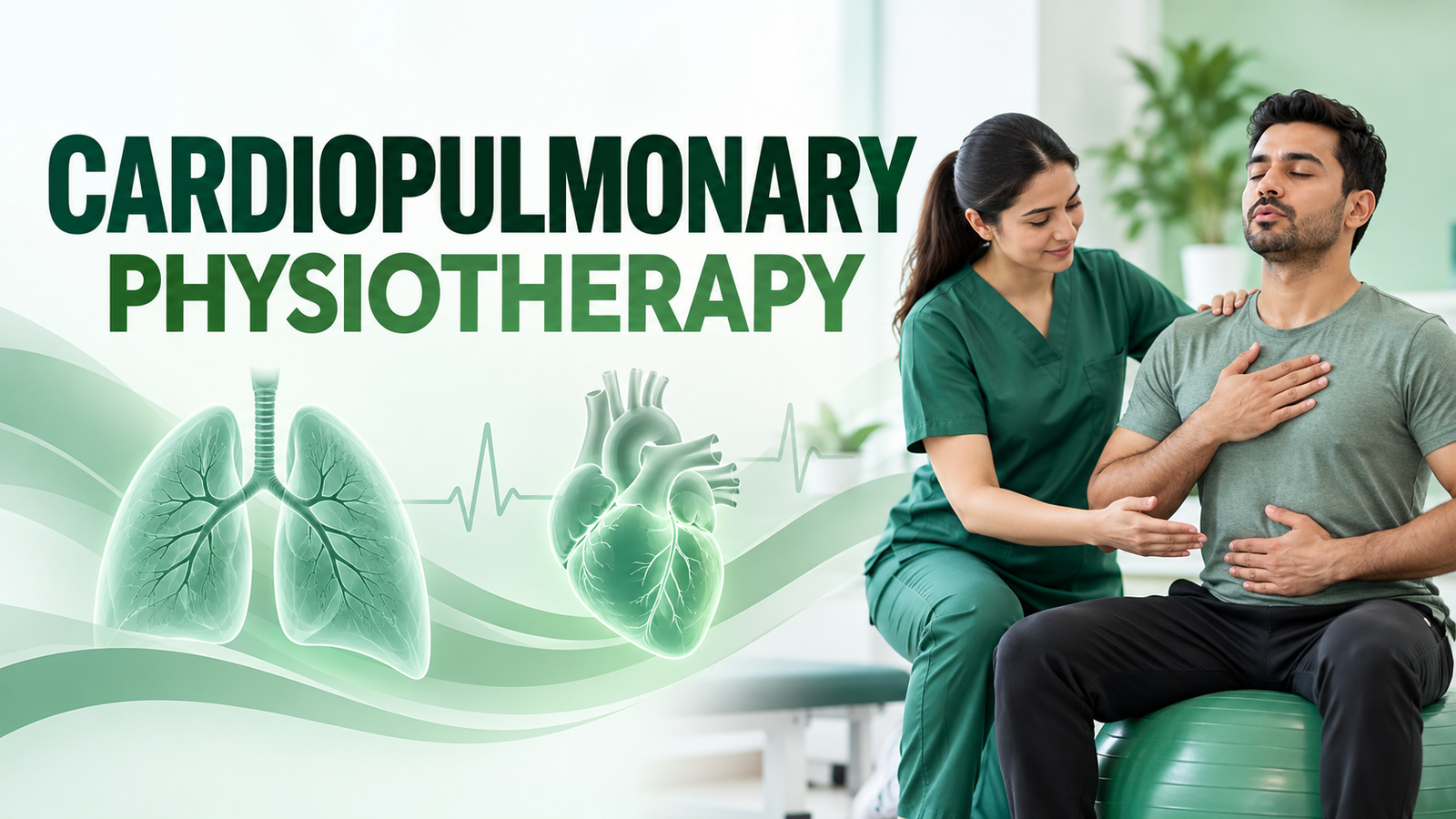
Cardiopulmonary Physiotherapy
Subject Summary
The public overview below follows the supplied PhysioVeda Academics subject summary.
Cardiopulmonary physiotherapy evaluates and restores function affected by heart and lung disease, surgery and critical illness. It integrates respiratory assessment, airway clearance when indicated, breathing strategies, exercise conditioning and patient education.
Clinical reasoning starts with the presenting problem: oxygenation and ventilation, secretion burden, circulatory stability, breathlessness, endurance and risk during movement. The chosen technique must match the mechanism, not merely the diagnostic label.
Safe rehabilitation monitors symptom response, oxygen requirement, vital signs and functional recovery. Sudden chest pain, new severe respiratory distress, syncope or an unstable physiological response requires immediate clinical reassessment.
This document follows the uploaded PhysioVeda Academics outline in its original sequence (14 topics, 75 subtopic entries). The explanations and practice examples are additional educational synthesis, not text supplied in the outline.
Whole-subject high-yield numbers
Use these supplied values and key facts for quick whole-subject revision.
| Item | Number / key fact |
|---|---|
| Resting adult pulse | Often approximately 60–100 beats/min; interpret age, medication, baseline and symptoms. |
| Resting adult respiratory rate | Often approximately 12–20 breaths/min; rate and work of breathing both matter. |
| Arterial blood pH | Approximately 7.35–7.45. |
| Arterial PaCO2 | Approximately 35–45 mmHg; reflects the ventilatory component of acid-base balance. |
| Arterial HCO3− | Approximately 22–26 mmol/L; reflects the metabolic component of acid-base balance. |
| Acute-care oxygen targets | Common guidance: SpO2 94–98% for most acutely ill adults; 88–92% for many at risk of hypercapnic respiratory failure pending assessment. Individual targets override these. |
| Pulse oximetry | Estimates oxygen saturation but not PaCO2, pH or ventilation; signal and clinical findings must agree. |
| Obstruction vs restriction | Reduced FEV1/FVC indicates airflow obstruction; restriction requires reduced total lung capacity to confirm. |
| Six-minute walk test | Measures six-minute walk distance; standard field-testing often uses a 30-m corridor. |
| Dyspnea/exertion scales | mMRC dyspnea grades 0–4; Borg CR10 grades 0–10, and Borg RPE uses 6–20. |
| Airway clearance | Select when secretion retention or ineffective cough is identified; not automatically for every respiratory diagnosis. |
| Exercise prescription | FITT = frequency, intensity, time, type; also specify progression, monitoring and safety. |
Core references
- PhysioVeda Academics. Cardiopulmonary Physiotherapy Topics and Subtopics. User-provided course outline (source for all 14 topic titles and 75 subtopic titles).
- Holland AE, Cox NS, Houchen-Wolloff L, et al. Defining Modern Pulmonary Rehabilitation: An Official American Thoracic Society Workshop Report. Ann Am Thorac Soc. 2021;18(5):e12–e29.
- Rochester CL, Alison JA, Carlin B, et al. Pulmonary Rehabilitation for Adults with Chronic Respiratory Disease: An Official American Thoracic Society Clinical Practice Guideline. Am J Respir Crit Care Med. 2023;208(4):e7–e26. doi:10.1164/rccm.202306-1066ST.
- American Heart Association. Core Components of Cardiac Rehabilitation Programs: 2024 Update. Professional Heart Daily; September 24, 2024. https://professional.heart.org/en/science-news/core-components-of-cardiac-rehabilitation-programs-2024-update
- O’Driscoll BR, Howard LS, Earis J, Mak V. BTS Guideline for Oxygen Use in Adults in Healthcare and Emergency Settings. Thorax. 2017;72(Suppl 1):ii1–ii90. doi:10.1136/thoraxjnl-2016-209729.
- Blakeman TC, Scott JB, Yoder MA, Capellari E, Strickland SL. AARC Clinical Practice Guidelines: Artificial Airway Suctioning. Respir Care. 2022;67(2):258–271. doi:10.4187/respcare.09548.
- ATS Committee on Proficiency Standards for Clinical Pulmonary Function Laboratories. ATS Statement: Guidelines for the Six-Minute Walk Test. Am J Respir Crit Care Med. 2002;166(1):111–117. doi:10.1164/ajrccm.166.1.at1102.
- Holland AE, Spruit MA, Troosters T, et al. An Official ERS/ATS Technical Standard: Field Walking Tests in Chronic Respiratory Disease. Eur Respir J. 2014;44(6):1428–1446. doi:10.1183/09031936.00150314.
- Hillegass E. Essentials of Cardiopulmonary Physical Therapy. Elsevier. Reference textbook for general cardiopulmonary assessment and rehabilitation concepts.
- Practice note: Physiotherapy assessment, airway procedures, oxygen titration, ventilator management and exercise progression require individualized clinical judgment, qualified professional oversight and applicable local protocols. Numeric ranges are study concepts rather than universal prescriptions.
Want to go deeper into Cardiopulmonary Physiotherapy?
Continue into the complete topic and subtopic learning system with structured summaries, medical visuals, topic wise OBQ practice, timed tests, explanations and results.