

Biomechanics
Understand forces, motion and mechanics of human movement.
General subject summary is free to everyone.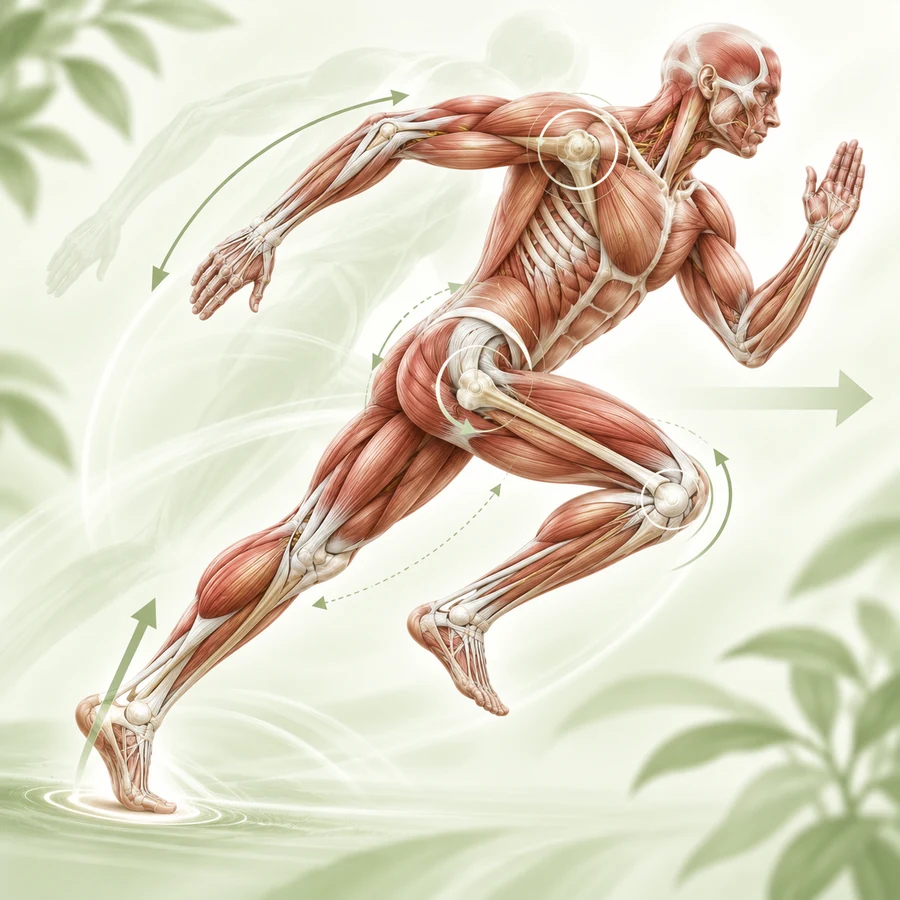
Biomechanics
Subject Summary
The public overview below follows the supplied PhysioVeda Academics subject summary.
Biomechanics applies the laws of mechanics to living systems and human movement. It explains how forces produce or resist motion and how tissues, joints and body segments respond to loading.
Kinematics describes motion without considering its cause, whereas kinetics studies the forces and moments that produce or modify motion.
Clinical biomechanics links physics with anatomy and movement analysis: force direction, moment arm, lever system, tissue stress, joint reaction force and muscle torque help explain why a movement is efficient, difficult or potentially injurious.
The subject progresses from basic mechanics and Newtonian principles to tissue behavior, joint mechanics, regional biomechanics, posture, balance and gait.
For physiotherapy, biomechanics supports assessment, exercise prescription, gait retraining, orthotic decisions, ergonomic advice, load management and interpretation of movement compensations.
Whole-subject high-yield formulas and numbers
Use these supplied values and key facts for quick whole-subject revision.
| Concept | Formula / key fact |
|---|---|
| Linear velocity | v = displacement / time |
| Linear acceleration | a = change in velocity / time |
| Newton second law | Sum F = m x a |
| Linear momentum | p = m x v |
| Impulse | Impulse = F x time = change in momentum |
| Moment / torque | M = F x perpendicular moment arm |
| Work | W = F x displacement x cos(theta) |
| Power | P = work / time; also P = F x velocity for collinear motion |
| Kinetic energy | KE = 1/2 m v^2 |
| Gravitational potential energy | PE = m g h |
| Stress | Stress = force / area |
| Strain | Strain = change in length / original length |
| Young modulus in linear elastic region | E = stress / strain |
| Static equilibrium | Sum F = 0 and Sum M = 0 |
| Walking gait cycle | Stance about 60%; swing about 40% at comfortable speed |
| Typical vertical GRF in walking | Two peaks commonly around 1.1-1.2 body weight; speed dependent |
Core textbook set used throughout
- Hall SJ. Basic Biomechanics. 9th ed. McGraw Hill; 2022.
- Hamill J, Knutzen KM, Derrick TR. Biomechanical Basis of Human Movement. 5th ed. Wolters Kluwer; 2021.
- Nordin M, Frankel VH, eds. Basic Biomechanics of the Musculoskeletal System. 5th ed. Wolters Kluwer; 2021.
- Neumann DA. Neumann's Kinesiology of the Musculoskeletal System: Foundations for Rehabilitation. 4th ed. Elsevier; 2024.
- Winter DA. Biomechanics and Motor Control of Human Movement. 4th ed. Wiley; 2009.
- Perry J, Burnfield JM. Gait Analysis: Normal and Pathological Function. 2nd ed. SLACK; 2010.
- Levangie PK, Norkin CC, Lewek MD. Joint Structure & Function: A Comprehensive Analysis. 6th ed. F.A. Davis; 2019.
Want to go deeper into Biomechanics?
Continue into the complete topic and subtopic learning system with structured summaries, medical visuals, topic wise OBQ practice, timed tests, explanations and results.