

Geriatric Physiotherapy
Geriatric physiotherapy addresses movement, mobility and functional problems in older adults while accounting for age-related physiological change, multimorbidity, frailty, cognition, medication effects, social context and individual goals.
General subject summary is free to everyone.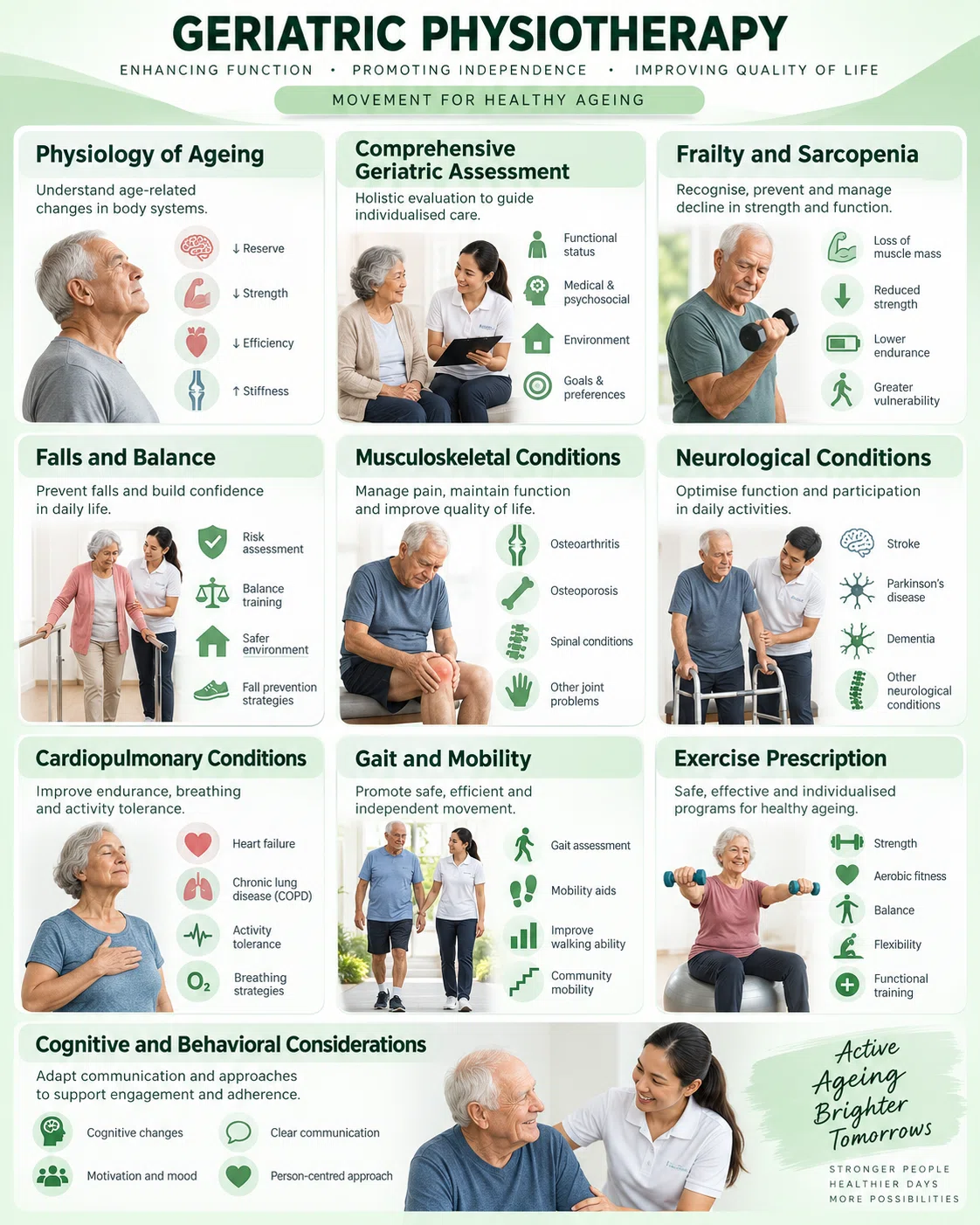
Geriatric Physiotherapy
Subject Summary
The public overview below follows the supplied PhysioVeda Academics subject summary.
Geriatric physiotherapy addresses movement, mobility and functional problems in older adults while accounting for age-related physiological change, multimorbidity, frailty, cognition, medication effects, social context and individual goals.
Ageing is highly variable. Chronological age alone does not determine capacity; two people of the same age may differ greatly in strength, endurance, balance, cognition, independence and rehabilitation potential.
Assessment is therefore multidimensional and combines mobility, balance, gait, cognition, activities of daily living, frailty, fall history, home environment and the medical conditions that influence exercise tolerance or safety.
Management emphasizes progressive strength and balance training, aerobic activity, functional practice, fall prevention, appropriate walking aids, education and environmental modification. Exercise is adapted to the person's reserve and progressed according to response rather than avoided because of age.
This summary follows the uploaded PhysioVeda Academics structure: physiology of ageing, comprehensive geriatric assessment, frailty/sarcopenia, falls, musculoskeletal, neurological and cardiopulmonary conditions, gait/mobility, exercise prescription, cognitive-behavioral issues, pelvic health, rehabilitation settings, and ethics/end-of-life care.
Key numbers and exam points to remember
Use these supplied values and key facts for quick whole-subject revision.
| Item | Number / key fact |
|---|---|
| Older-adult age threshold | Often >=65 years in clinical/epidemiological systems; function varies widely and age alone is insufficient |
| Fried frailty phenotype | 5 criteria; 0 robust, 1-2 prefrail, >=3 frail |
| Clinical Frailty Scale | 9-point scale commonly used clinically |
| SARC-F | 5 items; total 0-10, score >=4 commonly used to flag sarcopenia risk |
| Short Physical Performance Battery (SPPB) | 0-12 points |
| Berg Balance Scale | 0-56 points |
| Timed Up and Go | About >=12 s is commonly used as an elevated fall-risk screen; not diagnostic by itself |
| Low gait speed criterion | <=0.8 m/s is used in several frailty/sarcopenia frameworks |
| Osteoporosis DXA threshold | T-score <= -2.5 |
| Orthostatic hypotension | Fall in SBP >=20 mmHg or DBP >=10 mmHg within 3 min of standing |
| Aerobic activity target | 150-300 min/week moderate or 75-150 min/week vigorous, when appropriate |
| Strength training | Major muscle groups on >=2 days/week |
| Multicomponent balance/strength activity | Recommended on >=3 days/week for older adults |
Core references
- Avers D, Wong RA. Guccione's Geriatric Physical Therapy. 4th ed. Elsevier; 2020.
- O'Hanlon S, Smith R, eds. A Comprehensive Guide to Rehabilitation of the Older Patient. 4th ed. Elsevier; 2022.
- Cifu DX, ed. Braddom's Physical Medicine and Rehabilitation. 7th ed. Elsevier; 2026.
- Fulk GD, Chui KK, eds. O'Sullivan & Schmitz's Physical Rehabilitation. 8th ed. F.A. Davis; 2024.
- Kisner C, Borstad J, Colby LA. Therapeutic Exercise: Foundations and Techniques. 8th ed. F.A. Davis; 2023.
- American College of Sports Medicine. ACSM's Guidelines for Exercise Testing and Prescription. 12th ed. Wolters Kluwer; 2025.
- World Health Organization. WHO Guidelines on Physical Activity and Sedentary Behaviour. WHO; 2020.
- World Health Organization. Integrated Care for Older People (ICOPE): Guidance for Person-Centred Assessment and Pathways in Primary Care. WHO; 2019.
Want to go deeper into Geriatric Physiotherapy?
Continue into the complete topic and subtopic learning system with structured summaries, medical visuals, topic wise OBQ practice, timed tests, explanations and results.