
Orthopaedics and Traumatology
Orthopaedics and traumatology deal with disorders and injuries of bones, joints, muscles, tendons, ligaments, peripheral nerves and related soft tissues, with the goals of preserving life and limb, restoring alignment and stability, promoting healing and recovering function.
General subject summary is free to everyone.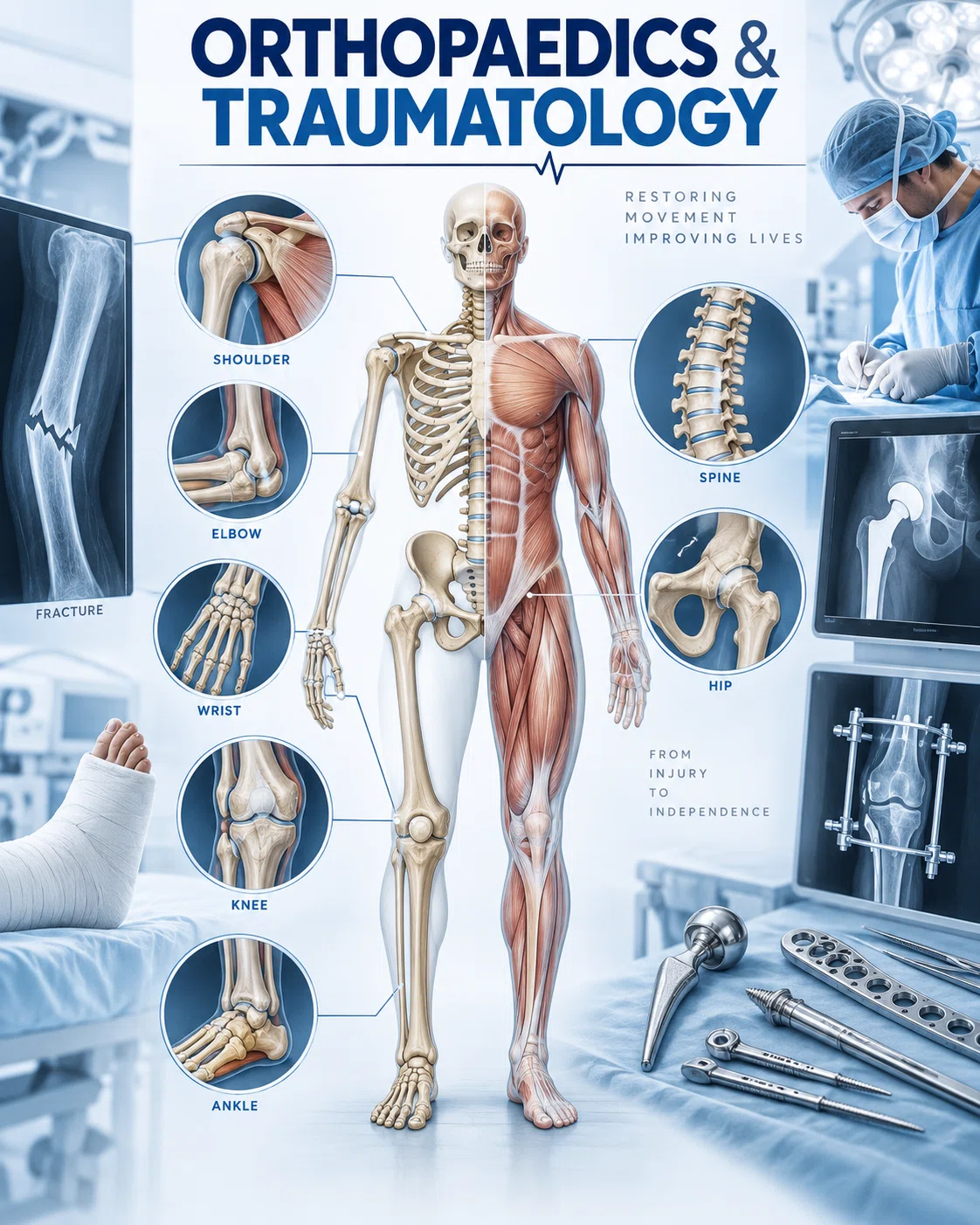
Orthopaedics and Traumatology
Subject Summary
The public overview below follows the supplied PhysioVeda Academics subject summary.
Orthopaedics and traumatology deal with disorders and injuries of bones, joints, muscles, tendons, ligaments, peripheral nerves and related soft tissues, with the goals of preserving life and limb, restoring alignment and stability, promoting healing and recovering function.
Orthopaedic assessment combines history, examination and appropriate investigations. In trauma, immediate priorities include recognition of life-threatening injury, neurovascular compromise, open wounds, compartment syndrome and unstable fractures or dislocations before definitive musculoskeletal management.
Fracture and soft-tissue management may use reduction, immobilization, traction, splints, casts, internal or external fixation, followed by rehabilitation that restores movement, strength, weight bearing and function according to tissue healing and surgical precautions.
Degenerative, inflammatory, metabolic, congenital and infective disorders require different diagnostic and management pathways. Examination findings should therefore be interpreted with age, mechanism, systemic features, imaging and laboratory information rather than in isolation.
This summary follows the PhysioVeda Academics structure: principles, fractures, dislocations, infection, congenital/developmental disorders, metabolic bone disease, inflammatory/degenerative joint disease, spine, regional upper- and lower-limb disorders, orthopaedic surgery and amputation.
Key numbers and exam points to remember
Use these supplied values and key facts for quick whole-subject revision.
| Item | Number / key fact |
|---|---|
| Broad fracture-healing phases | 3 overlapping phases: inflammatory, reparative, remodeling |
| Salter-Harris physeal injury | 5 classic types: I-V |
| Gustilo-Anderson open-fracture grades | I, II, IIIA, IIIB, IIIC |
| Osteoporosis by DXA T-score | <= -2.5 at accepted skeletal sites in appropriate adults |
| Osteopenia / low bone mass T-score | Between -1.0 and -2.5 |
| Classic clubfoot components | 4: cavus, adductus, varus, equinus (CAVE) |
| Meyerding spondylolisthesis grades | I-V based on percentage vertebral slip |
| Radiographic definition of scoliosis | Cobb angle >= 10 degrees with vertebral rotation |
| Common ankle-ligament sprain grading | Grades I, II, III |
| AC joint injury Rockwood classification | Types I-VI |
| Major lower-limb amputation levels | Transtibial and transfemoral are common major levels |
Core references
- Azar FM, Sawyer JR, Throckmorton TW, eds. Campbell's Operative Orthopaedics. 15th ed. Elsevier; 2026.
- Tornetta P III, Ricci WM, Ostrum RF, McKee MD, Ollivere BJ, de Ridder VA, eds. Rockwood and Green's Fractures in Adults. 10th ed. Wolters Kluwer; 2024.
- Manske RC, Magee DJ. Magee's Orthopedic Physical Assessment. 8th ed. Elsevier; 2026.
- Solomon L, Warwick D, Nayagam S. Apley's System of Orthopaedics and Fractures. 10th ed. CRC Press; 2018.
- Kisner C, Borstad J, Colby LA. Therapeutic Exercise: Foundations and Techniques. 8th ed. F.A. Davis; 2023.
- Cifu DX, ed. Braddom's Physical Medicine and Rehabilitation. 7th ed. Elsevier; 2026.
Want to go deeper into Orthopaedics and Traumatology?
Continue into the complete topic and subtopic learning system with structured summaries, medical visuals, topic wise OBQ practice, timed tests, explanations and results.