

Surgery
Review core surgical principles, perioperative care, trauma and common surgical rehabilitation considerations.
General subject summary is free to everyone.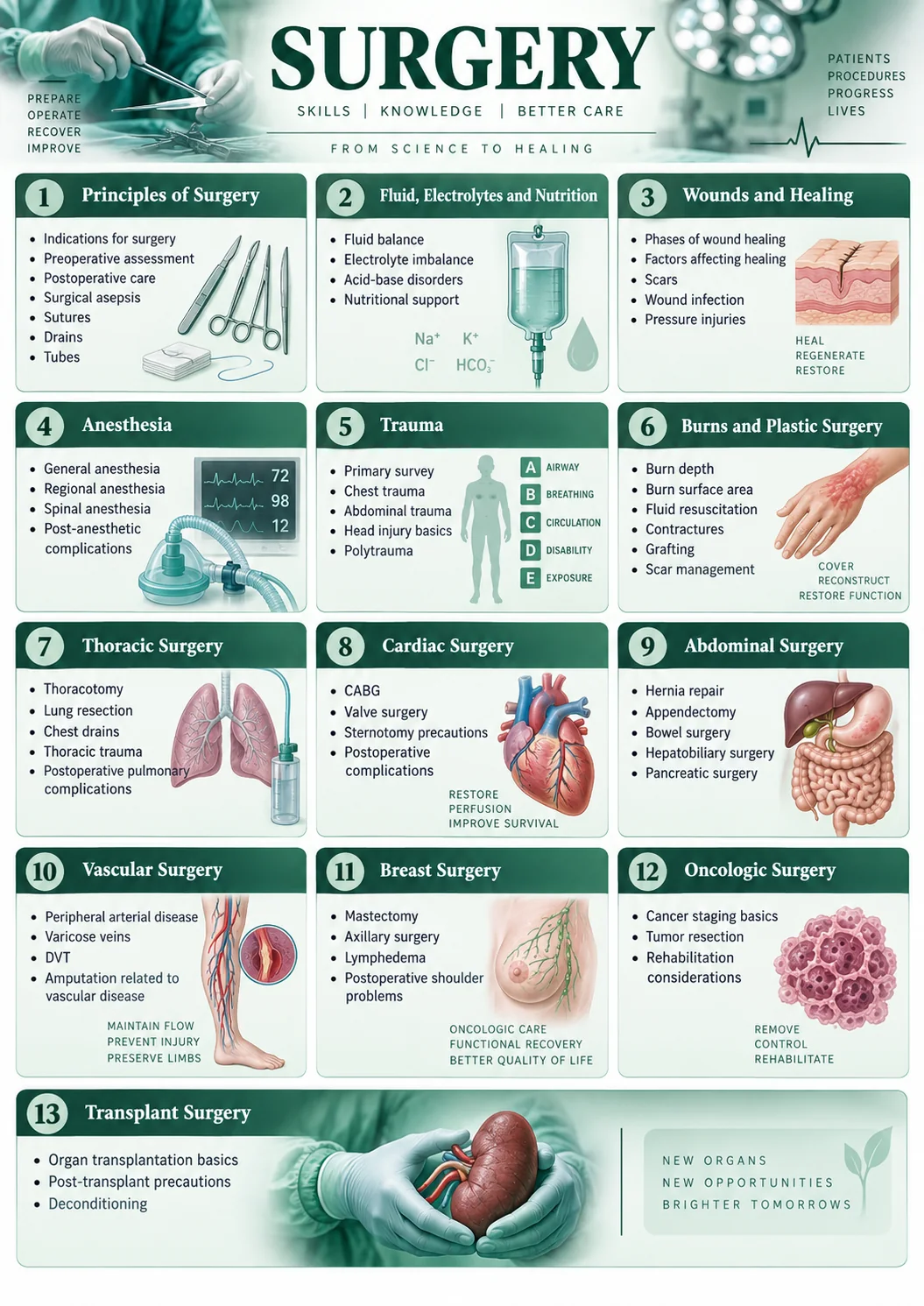
Surgery
Subject Summary
The public overview below follows the supplied PhysioVeda Academics subject summary.
General surgery applies surgical principles to the assessment and management of patients before, during and after operative treatment, with emphasis on safety, tissue healing, physiological stability and restoration of function.
A surgical problem is approached by defining the indication for intervention, evaluating operative and anesthetic risk, preparing the patient, preventing infection and thromboembolic complications, and planning postoperative recovery.
For physiotherapy and rehabilitation, surgical knowledge is especially relevant to early mobilization, respiratory care, wound and drain precautions, pain-limited movement, venous-thromboembolism prevention, postoperative weakness and safe progression of activity.
Trauma, burns, thoracic and cardiac surgery, abdominal and vascular procedures, breast and cancer surgery, and transplantation all require condition-specific precautions while avoiding unnecessary immobilization and deconditioning.
This summary follows the uploaded PhysioVeda Academics structure: Principles of Surgery, Fluid/Electrolytes/Nutrition, Wounds and Healing, Anesthesia, Trauma, Burns and Plastic Surgery, Thoracic, Cardiac, Abdominal, Vascular, Breast, Oncologic and Transplant Surgery.
Whole-subject high-yield numbers
Use these supplied values and key facts for quick whole-subject revision.
| Adult total body water | Approximately 50-60% of body weight; varies with age, sex and body composition |
| Serum sodium | Approximately 135-145 mmol/L |
| Serum potassium | Approximately 3.5-5.0 mmol/L |
| Arterial pH | 7.35-7.45 |
| Classic wound-healing phases | 3 overlapping phases: inflammatory, proliferative and remodeling |
| Trauma primary survey | ABCDE: Airway, Breathing, Circulation, Disability, Exposure |
| Glasgow Coma Scale | 3-15 |
| Adult burn area estimate | Rule of Nines; Lund-Browder chart is more accurate across age groups |
| Classic Parkland teaching formula | 4 mL crystalloid x body weight (kg) x %TBSA burn in first 24 h; individualize to clinical response |
| Parkland timing | Traditionally half in first 8 h from time of burn, remainder over next 16 h |
| Pressure injury classification | Stages 1-4 plus unstageable and deep-tissue pressure injury categories |
| PAD screening | An ankle-brachial index below about 0.90 generally supports peripheral arterial disease |
| Cancer staging framework | TNM: primary Tumor, regional Nodes, distant Metastasis |
Want to go deeper into Surgery?
Continue into the complete topic and subtopic learning system with structured summaries, medical visuals, topic wise OBQ practice, timed tests, explanations and results.