

Kinesiology
Study human movement, joint motion and muscle function.
General subject summary is free to everyone.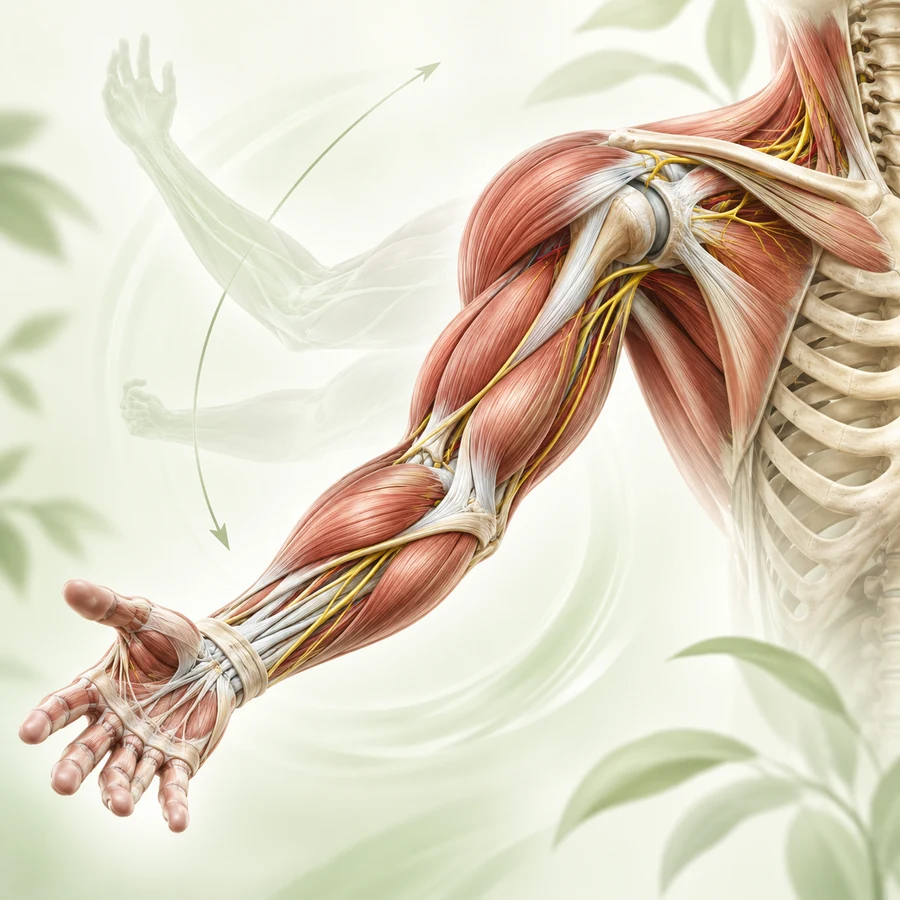
Kinesiology
Subject Summary
The public overview below follows the supplied PhysioVeda Academics subject summary.
Kinesiology is the study of human movement by integrating anatomy, biomechanics, arthrology, muscle function and motor control.
For physiotherapy, kinesiology should be learned functionally: which joint moves, in which plane and axis, what muscle or force couple produces or controls the motion, and how the movement changes during tasks such as gait, stairs, lifting, reaching and sit-to-stand.
This document follows the uploaded PhysioVeda Academics structure: Foundations, Scapula, Shoulder, Elbow/Forearm, Wrist/Hand, Spine, Pelvis/Hip, Knee, Ankle/Foot, Posture, Gait and Functional Movement.
High-yield numbers are included for joint ranges, gait timing, movement ratios and functional positions. Where a traditional value such as the 2:1 scapulohumeral rhythm is useful but not fixed, it is clearly described as an approximation.
Clinical tables emphasize movement, prime movers, stabilizers, common compensations and the observable movement a physiotherapist sees during examination.
Whole-subject high-yield numbers
Use these supplied values and key facts for quick whole-subject revision.
| Item | Number / key fact |
|---|---|
| Principal anatomical planes | 3: sagittal, frontal, transverse |
| Principal axes | 3: mediolateral, anteroposterior, vertical |
| Classic scapulohumeral contribution during elevation | Approx. 2:1 GH:scapulothoracic after the early phase; variable |
| Typical shoulder elevation | Approx. 180° total |
| Functional elbow arc | Approx. 30-130° flexion |
| Forearm rotation | Approx. 80-90° supination; 75-80° pronation |
| Typical hip flexion | Approx. 120° with knee flexed |
| Typical knee flexion | Approx. 135° |
| Typical ankle dorsiflexion / plantarflexion | Approx. 20° / 50° |
| Gait cycle | Stance ~60%; swing ~40% at comfortable speed |
| Perry gait phases | 8 phases |
| Comfortable adult walking speed | Often ~1.2-1.4 m/s; population dependent |
Core textbook set used throughout
- Neumann DA. Neumann's Kinesiology of the Musculoskeletal System: Foundations for Rehabilitation. 4th ed. Elsevier; 2024.
- Levangie PK, Norkin CC, Lewek MD. Joint Structure & Function: A Comprehensive Analysis. 6th ed. F.A. Davis; 2019.
- Kisner C, Borstad J, Colby LA. Therapeutic Exercise: Foundations and Techniques. 8th ed. F.A. Davis; 2023.
- Conroy VM, Murray B, Alexopulos Q, McCreary J. Kendall's Muscles: Testing and Function with Posture and Pain. 6th ed. Wolters Kluwer; 2023.
- Perry J, Burnfield JM. Gait Analysis: Normal and Pathological Function. 2nd ed. CRC Press/SLACK; 2010.
Want to go deeper into Kinesiology?
Continue into the complete topic and subtopic learning system with structured summaries, medical visuals, topic wise OBQ practice, timed tests, explanations and results.