
Genetics
Genetics is the study of heredity, variation and the organization, transmission and expression of genetic information from DNA to cells, tissues and whole organisms.
General subject summary is free to everyone.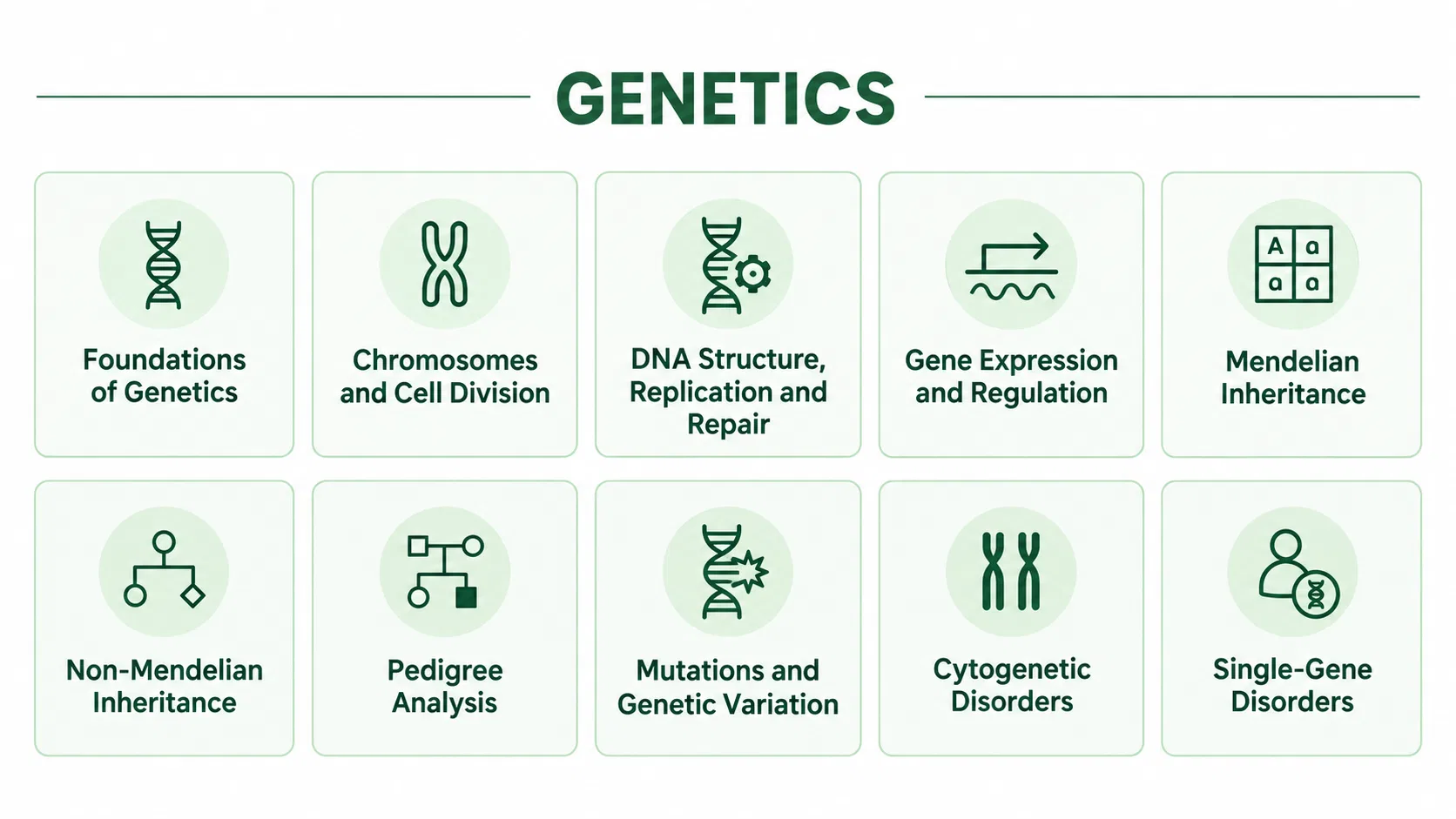
Genetics
Subject Summary
The public overview below follows the supplied PhysioVeda Academics subject summary.
Genetics is the study of heredity, variation and the organization, transmission and expression of genetic information from DNA to cells, tissues and whole organisms.
Medical genetics links chromosome biology, gene structure, inheritance patterns, molecular mechanisms and population variation with human disease, diagnosis, prevention and counseling.
A practical approach is to identify the type of genetic change, determine whether it is chromosomal, single-gene, mitochondrial, multifactorial or acquired, and then relate the mechanism to inheritance risk and appropriate testing.
Genetic information is probabilistic rather than deterministic in many conditions. Penetrance, expressivity, environmental effects, mosaicism, epigenetic regulation and background genetic variation can all modify the phenotype.
This summary follows the uploaded PhysioVeda Academics structure: foundations, chromosomes and cell division, DNA, gene expression, Mendelian and non-Mendelian inheritance, pedigrees, mutations, cytogenetic and single-gene disorders, complex inheritance, population genetics, testing, prenatal/reproductive genetics, counseling, and genomics/precision medicine.
Whole-subject high-yield numbers
Use these supplied values and key facts for quick whole-subject revision.
| Human somatic chromosome number | 46 chromosomes = 23 pairs |
| Autosome pairs | 22 pairs |
| Sex-chromosome pair | 1 pair |
| Gamete chromosome number | 23 chromosomes |
| Approximate haploid genome size | ~3.2 billion base pairs |
| Protein-coding genes | About 20,000; exact annotation changes over time |
| Mitosis | 1 DNA replication followed by 1 cell division -> 2 genetically similar daughter cells |
| Meiosis | 1 DNA replication followed by 2 divisions -> haploid gametes |
| Autosomal dominant risk | Affected heterozygous parent x unaffected parent: 50% risk per pregnancy |
| Autosomal recessive carrier couple | 25% affected, 50% carrier, 25% unaffected/noncarrier per pregnancy |
| Hardy-Weinberg | p + q = 1; p² + 2pq + q² = 1 for a two-allele locus under assumptions |
| Down syndrome | Usually trisomy 21 |
| Edwards syndrome | Trisomy 18 |
| Patau syndrome | Trisomy 13 |
| Turner syndrome | Classically 45,X |
| Klinefelter syndrome | Classically 47,XXY |
| Ideal PCR amplification | Approximately 2^n copies after n cycles under idealized doubling |
Core references
- Nussbaum RL, McInnes RR, Willard HF. Thompson & Thompson Genetics in Medicine. 8th ed. Elsevier.
- Turnpenny PD, Ellard S, Cleaver R. Emery's Elements of Medical Genetics and Genomics. 16th ed. Elsevier.
- Strachan T, Read AP. Human Molecular Genetics. 5th ed. Garland Science.
- Jorde LB, Carey JC, Bamshad MJ. Medical Genetics. 6th ed. Elsevier.
Want to go deeper into Genetics?
Continue into the complete topic and subtopic learning system with structured summaries, medical visuals, topic wise OBQ practice, timed tests, explanations and results.