

First Aid and Emergency Care
First aid and emergency care are the immediate actions taken to preserve life, prevent further harm and support recovery until definitive medical care is available.
General subject summary is free to everyone.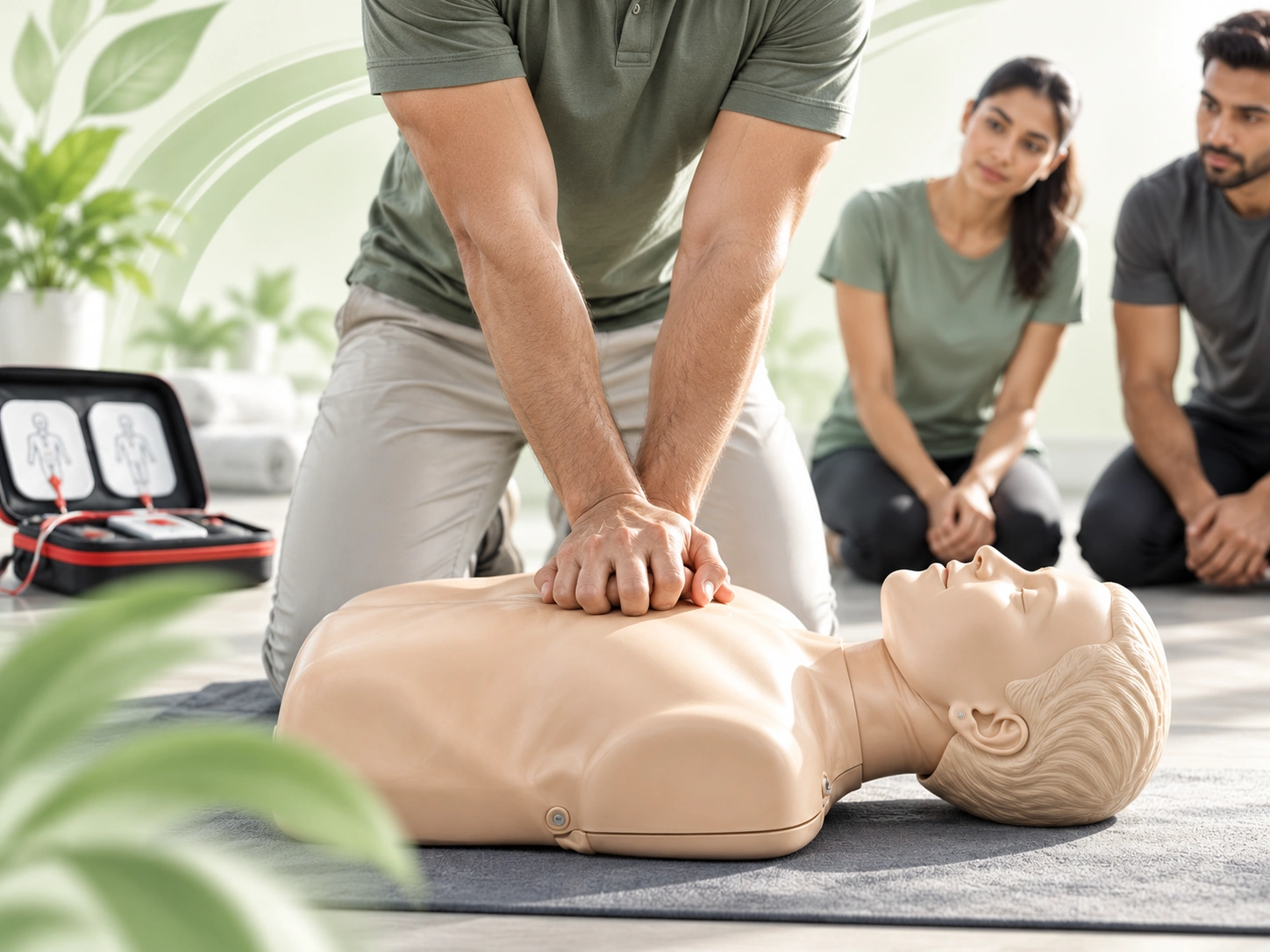
First Aid and Emergency Care
Subject Summary
The public overview below follows the supplied PhysioVeda Academics subject summary.
First aid and emergency care are the immediate actions taken to preserve life, prevent further harm and support recovery until definitive medical care is available.
A safe response begins with scene assessment and personal protection, followed by rapid recognition of airway, breathing, circulation and neurological threats and early activation of emergency medical services.
High-quality CPR, prompt AED use, hemorrhage control, appropriate positioning, protection of suspected fractures or spinal injuries and rapid referral are core lifesaving priorities.
First aid should stay within the responder's training and local protocol. The responder should avoid harmful actions, continually reassess the patient and provide a structured handover to emergency personnel.
This summary follows the uploaded PhysioVeda Academics structure across 37 topics, from basic first-aid principles and resuscitation to trauma, medical emergencies, transport, infection prevention and legal/ethical communication.
Whole-subject high-yield numbers
Use these supplied values and key facts for quick whole-subject revision.
| Adult chest-compression rate | 100-120/min |
| Adult compression depth | At least 5 cm, avoid >6 cm |
| Adult CPR ratio | 30 compressions : 2 breaths when giving conventional CPR |
| Child/infant single-rescuer ratio | 30:2 |
| Child/infant two-rescuer ratio | 15:2 in trained pediatric BLS |
| Child compression depth | At least one third AP chest depth, about 5 cm |
| Infant compression depth | At least one third AP chest depth, about 4 cm |
| Infant compression technique | Heel of 1 hand or 2-thumb encircling-hands technique |
| Severe choking: adult/child | Alternate 5 back blows + 5 abdominal thrusts |
| Severe choking: infant | Alternate 5 back blows + 5 chest thrusts |
| FAST stroke screen | Face, Arm, Speech, Time |
| Primary survey | ABCDE |
| Normal adult respiratory rate | About 12-20 breaths/min at rest |
| Normal adult pulse | Often about 60-100 beats/min at rest |
| Hypoglycemia conscious first aid | Give fast-acting glucose if able to swallow; reassess and escalate if not improving |
Core references
- American College of Emergency Physicians. First Aid Manual. 6th ed. DK; 2021.
- Tintinalli JE, Ma OJ, Yealy DM, et al., eds. Tintinalli's Emergency Medicine: A Comprehensive Study Guide. 10th ed. McGraw Hill; 2024.
- Walls RM, Hockberger RS, Gausche-Hill M, eds. Rosen's Emergency Medicine: Concepts and Clinical Practice. 10th ed. Elsevier; 2023.
- Campbell JE, Alson RL, eds. International Trauma Life Support for Emergency Care Providers. 9th ed. Pearson; 2019.
Want to go deeper into First Aid and Emergency Care?
Continue into the complete topic and subtopic learning system with structured summaries, medical visuals, topic wise OBQ practice, timed tests, explanations and results.