
Medical MCQ Practice: Learn, Test and Revise Smarter
How to turn questions into an active learning system with PhysioVeda Academics

Key Takeaways
- Medical MCQ practice is most useful when questions are used to retrieve knowledge, reveal gaps and guide the next revision session.
- Topic-wise questions, explanations and timed testing serve different purposes and work best when combined with proper subject learning.
- PhysioVeda Academics connects structured summaries, question practice, tests, results and further revision in one workflow.
- The current PhysioVeda Academics platform contains more than 2 million active questions across installed subject banks, with a 45-subject public library.
- Question banks should supplement—not replace—textbooks, university teaching, practical training or clinical education.
You finish a pharmacology chapter and everything feels familiar. The mechanisms look clear, the drug names are recognisable and the notes make sense. Then you close the book, attempt five questions and discover that two options look almost identical. One mechanism becomes difficult to explain. Another question exposes a topic you barely remember.
That gap between recognising information and being able to retrieve or apply it is exactly why medical MCQ practice can be valuable. Multiple Choice Questions (MCQs) and Objective Based Questions (OBQs, in PhysioVeda Academics terminology) can turn revision from passive review into a cycle of learning, testing, checking, analysing and improving.
The purpose is not simply to answer more questions. It is to discover what you genuinely know, what you only recognise, and what needs another round of revision.
In This Guide
- What is medical MCQ practice?
- Why question practice can strengthen learning
- From passive reading to active learning
- How MCQs reveal weak areas
- Why explanations matter
- Topic-wise vs mixed practice
- How PhysioVeda Academics uses MCQs and OBQs
- Who can use the platform?
- Plans and pricing
- How to practise more effectively
- FAQs
What Is Medical MCQ Practice?
Medical MCQ practice means using structured multiple-choice questions to test knowledge across medical and healthcare subjects. A question may ask for a factual answer, require comparison between alternatives, or present a short clinical scenario that asks the learner to connect a finding with an underlying anatomical, physiological or pathological concept.
For example, a recall question might ask which cranial nerve supplies the lateral rectus muscle. A more applied version might describe diplopia and inability to abduct an eye, then ask which cranial nerve is affected. The underlying knowledge is related, but the second question requires the learner to connect a clinical sign with anatomy.
PhysioVeda Academics also uses the term OBQ for Objective Based Question. For the terminology in more detail, read our guide to OBQs and MCQs in healthcare education.
Why Can Question Practice Strengthen Learning?
Reading is essential, but repeated exposure to the same notes can create familiarity without proving that the information can be retrieved independently. Medical MCQ practice removes many of the cues that come from seeing headings, diagrams and surrounding paragraphs. The learner has to decide which knowledge is relevant and select an answer.
A 2025 state-of-the-art review in the health professions describes retrieval practice—actively recalling information from memory—as a learning strategy with strong support in cognitive psychology and widespread use across medicine, nursing and dentistry. A systematic review of distributed and retrieval practice in health-professions education also evaluated the effects of recalling information and spacing learning over time. See the PubMed review on retrieval practice in the health professions and the systematic review in Advances in Health Sciences Education.
That does not mean every MCQ automatically produces better learning. Question quality, feedback, prior understanding and how the learner reviews mistakes all matter. The evidence is a reason to use questions deliberately—not a reason to replace proper study with endless clicking.
From Passive Reading to Active Learning
When you read a summary, information is being presented to you. During medical MCQ practice, you have to do something with that information. You may need to retrieve a fact, compare alternatives, interpret a scenario or connect two concepts.
Consider cardiac output: reading tells you that cardiac output equals heart rate multiplied by stroke volume. A question asking what happens when stroke volume falls while heart rate remains unchanged requires you to use the relationship rather than merely recognise the formula.
This is why a good revision system should move back and forth between learning and testing. If a question exposes a gap, the next step is often to reopen the concept—not simply answer another hundred questions.
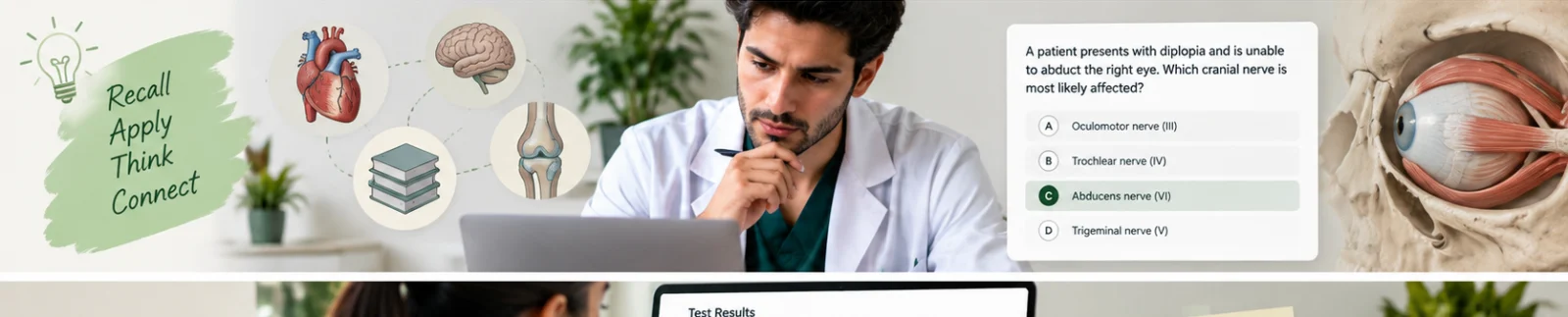
Medical MCQ Practice Can Show You What to Revise Next
One of the strongest practical uses of medical MCQ practice is that it can make weak areas visible. Imagine completing a pharmacology set and performing well in antibiotics and analgesics but repeatedly struggling with autonomic pharmacology. The overall percentage matters, but the pattern is more useful: it tells you what should receive attention next.
The same principle applies across healthcare subjects. An Anatomy learner may be comfortable with upper-limb questions but uncertain in neuroanatomy. A physiotherapy student may perform strongly in Exercise Therapy yet repeatedly miss Biomechanics concepts. Once the pattern becomes visible, revision becomes more focused.
That is the logic behind the PhysioVeda Academics cycle: Learn → Practise → Test → Analyse → Improve.
Why Answer Explanations Matter
If a question only says “Correct answer: C,” you know whether your response was right, but you may still not understand why. Effective medical MCQ practice becomes more educational when feedback explains the concept being tested and clarifies why the correct answer fits.
Explanations matter even when you answered correctly. A correct response can still be a guess between two options. Reviewing the explanation helps distinguish genuine understanding from luck and can reveal a misconception before it becomes a repeated error.
PhysioVeda Academics connects question attempts with explanations and results so learners can review correct, incorrect and unanswered questions rather than seeing only a final percentage.
Topic-Wise Medical MCQs vs Mixed Question Practice
Both focused and mixed testing have a place. Topic-wise medical MCQ practice is useful immediately after studying a defined area—for example the rotator cuff, cardiac output, autonomic pharmacology or brachial plexus. You can quickly check whether that study session produced usable knowledge.
Mixed testing serves a different purpose. Once several topics have been learned, broader question sets require you to identify which knowledge applies without being told the topic in advance. That adds a different retrieval challenge and can be useful later in revision.
On PhysioVeda Academics, learners can move from subject summaries and topic learning into topic-wise OBQs and timed tests. Test sizes currently include 25, 50 and 100 questions, giving learners a way to move from shorter practice to more sustained testing.
Medical MCQ Practice for Exam Preparation
Examinations are not the only reason to answer questions, but medical MCQ practice can help students become more comfortable interpreting stems, comparing similar options, retrieving knowledge without notes and working under time pressure.
There is an important limitation: doing thousands of questions does not guarantee examination success. If a learner repeatedly misses renal physiology because the underlying concept is not understood, another large question set may not solve the problem. The better action may be to stop, learn the concept properly, then return to questions.
Question practice should guide learning—not replace it.
How PhysioVeda Academics Uses Medical MCQ Practice
PhysioVeda Academics is designed as a multidisciplinary healthcare learning platform rather than only a question bank. Medical MCQ practice sits inside a broader system of structured learning, topic-wise questions, timed tests, explanations, performance information and repeated revision.
Platform figures above were verified from the live PhysioVeda Academics site and question database on 1 October 2026. Subject-library count and installed-question-bank count are intentionally shown separately.
A learner can begin with the subject library, open a relevant subject, review structured material, practise questions and use results to identify what needs another look. The complete platform guide explains this workflow in more detail, while What Is PhysioVeda Academics? explains the wider purpose of the platform.
The platform also includes Knowledge Search for eligible members, an interactive 3D Anatomy Lab with Full Access, and a Leaderboard designed around meaningful test activity rather than raw clicks.
Not Just for One Profession
PhysioVeda Academics is being built around the idea that foundational and clinical knowledge overlaps across healthcare education. The platform supports learners who want to revisit shared medical sciences while keeping profession-specific education and official curricula in their proper place.
Who Can Use Medical MCQ Practice on PhysioVeda Academics?
Medical and MBBS Students
Medical students can use relevant foundational and clinical subjects such as Anatomy, Physiology, Biochemistry, Pathology, Pharmacology, Microbiology, Genetics, Immunology, Medicine and Surgery. medical question practice can be used after studying a topic to check whether information can still be retrieved without the notes in front of you.
DPT, BPT and Physiotherapy Students
Physiotherapy learners move between foundational science, movement science and rehabilitation. Subjects such as Anatomy, Physiology, Biomechanics, Kinesiology, Exercise Therapy, Electrotherapy and rehabilitation-focused areas make question-based revision useful across different stages of training.
Nursing, Pharmacy, Dentistry and Allied Health
Many healthcare programmes share foundational sciences. Learners can use subjects that overlap with their formal programme, while treating PhysioVeda Academics as a supplementary learning resource rather than a replacement for university curricula or profession-specific teaching.
Healthcare Professionals
For professionals, medical question practice can be used differently: not necessarily to prepare for an exam, but to find out which foundational areas have become less familiar and deserve refreshing.
PhysioVeda Academics Subscription Plans
The article is primarily informational, but learners who want to use the full platform should understand the current access model. PhysioVeda Academics is subscription-based, with a small Anatomy-only trial and two Full Access durations.
See the live PhysioVeda Academics pricing page for the current terms and access details, or try the free demo test before choosing a plan.

How to Make medical question practice More Effective
Doing more questions is not automatically the same as learning more. A learner who rushes through 200 questions and ignores every explanation may gain less than someone who carefully works through a smaller set and investigates each mistake.
- Study the concept first. Questions work best when there is knowledge to retrieve.
- Answer before checking notes. Give your memory a genuine chance to retrieve the information.
- Mark uncertainty mentally. A correct guess is not the same as confident understanding.
- Read the explanation. Especially when the answer was wrong, uncertain or guessed.
- Look for patterns. Repeated errors in the same topic are more actionable than one isolated mistake.
- Return to weak material. Use your results to decide what to revise next.
- Retest later. Check whether the weakness remains after revision.
- Add timed tests gradually. Time pressure is useful for exam preparation, but it should not replace careful thinking during early learning.
Used this way, medical question practice becomes part of a learning loop rather than a last-minute activity performed only before an examination.
Common Mistakes When Using Medical Question Banks
One mistake is memorising the answer instead of understanding the concept. If you remember that “B was correct last time,” you can appear to improve without actually learning anything new. Another mistake is practising only subjects you enjoy because high scores feel reassuring.
A third mistake is treating every wrong answer as a problem with the question. Some questions can certainly be imperfect, but repeated difficulty in the same area may indicate a knowledge gap. Finally, an MCQ score should never be confused with complete clinical competence. Healthcare practice also depends on communication, examination skills, practical ability, professional judgement and real-world decision-making.
UPDATE. UPGRADE. REVISE.
The value of medical question practice becomes clearer when it is treated as part of an ongoing learning habit. UPDATE what you know by returning to topics that have become less familiar. UPGRADE your understanding by learning why an answer is correct rather than only remembering the option. REVISE what needs attention by using mistakes and uncertainty to plan the next study session.
That is a more useful goal than chasing a large question count for its own sake.
Frequently Asked Questions
What is medical question practice?
medical question practice is the use of structured multiple-choice questions to test recall, understanding and application across medical and healthcare subjects. It is most useful when paired with explanations and proper subject learning.
What does MCQ stand for?
MCQ stands for Multiple Choice Question. The learner selects the correct or most appropriate answer from several options.
What does OBQ mean on PhysioVeda Academics?
Within PhysioVeda Academics, OBQ means Objective Based Question: a structured question designed for an objectively assessable response.
Can medical MCQs help with exam preparation?
They can support recall, self-assessment and timed-practice skills, but should be combined with the textbooks, lectures, practical teaching and official resources required for the specific examination.
Should I read explanations after a correct answer?
Often yes. A correct answer may still have been a guess, and the explanation can confirm the reasoning or clarify why other options are less appropriate.
How many questions are on PhysioVeda Academics?
As verified on 1 October 2026, the live question database contains more than 2 million active questions across 30 installed question-bearing subjects. The public subject library currently lists 45 subjects.
Is PhysioVeda Academics free?
A free demo is available. Current paid options include a $10 five-day Anatomy-only trial, $69 for six months of Full Access and $109 for one year of Full Access. Current terms should always be checked on the live pricing page.
Does PhysioVeda Academics replace university teaching or textbooks?
No. It is designed as a supplementary healthcare learning platform and should be used alongside formal curricula, textbooks, practical education and clinical teaching.
The Real Value of medical question practice
A useful question does more than produce a score. Sometimes it confirms that you understand the topic. Sometimes it exposes a small gap. Occasionally it tells you that an entire area needs to be studied again. All three outcomes are useful.
The smarter question after a test is not only “How many did I get right?” It is “What did this test tell me to revise next?” PhysioVeda Academics brings that idea into one learning environment through structured subject summaries, topic-wise questions, explanations, timed testing and saved performance information.
If you want to experience the workflow before subscribing, start with the free demo, explore the subject library, or review the current Full Access plans.
Prepared by the PhysioVeda Academics Editorial Team using the supplied article draft as the editorial foundation, updated with live platform information verified on 1 October 2026 and peer-reviewed literature on retrieval practice. This article is educational and does not replace university curricula, professional training, examination blueprints or clinical guidance.