
Biomechanics MCQs: 10 Torque and Moment-Arm Problems
Solve 10 free biomechanics MCQs on torque, moment arms and static balance. Check worked answers, units and a reusable calculation worksheet.
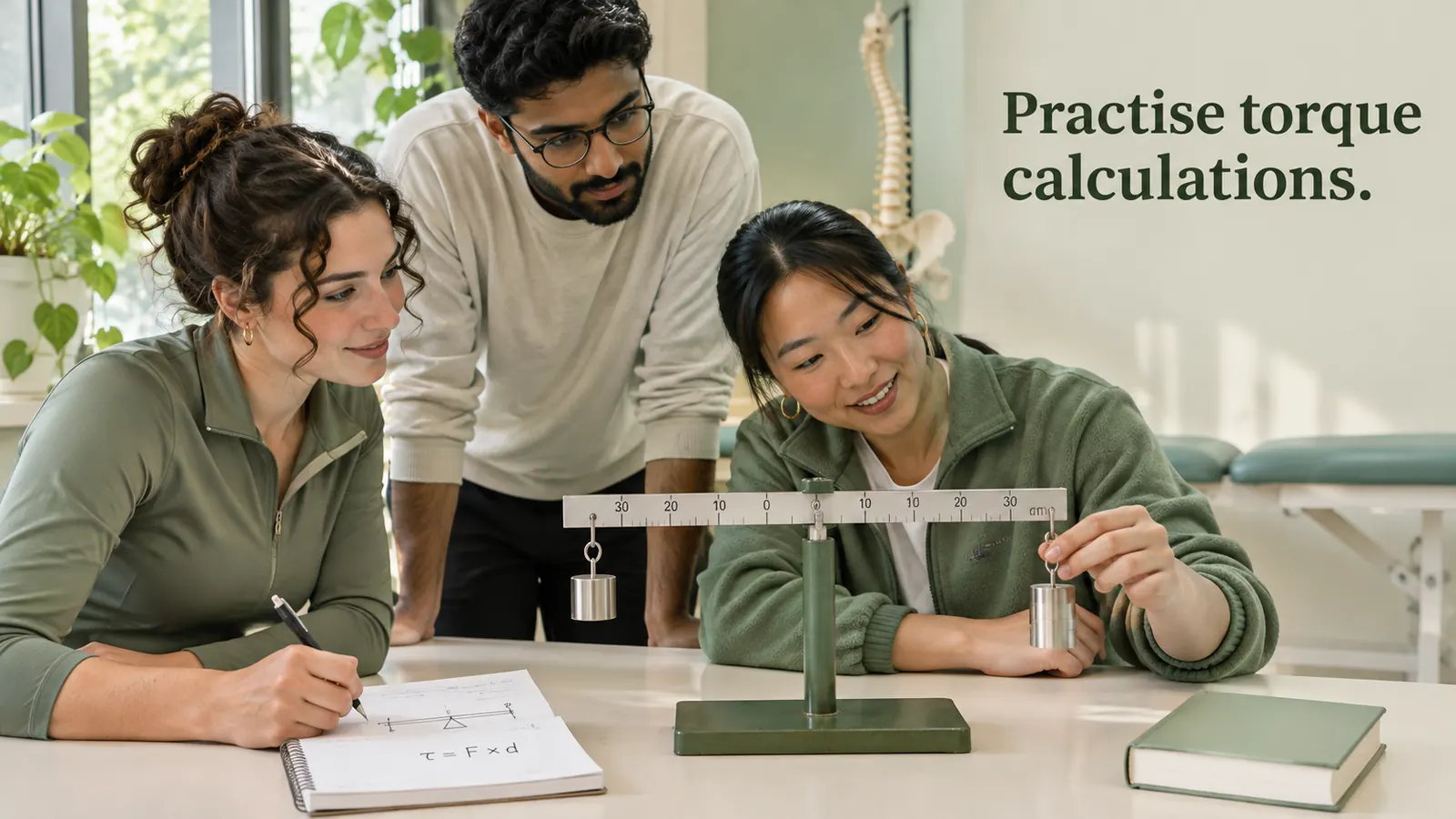
These biomechanics MCQs practise the calculation behind a turning effect. Work through ten original introductory problems, then reveal each answer. Use a calculator if helpful. All limb examples are simplified classroom models with the stated forces only.
What you’ll practise
- Find perpendicular distance before multiplying force by distance.
- Convert centimetres to metres and report torque in N·m.
- Balance clockwise and counterclockwise moments about the same pivot.
Biomechanics MCQs with answers and explanations
Choose one best answer, A–D. Open each answer when you are ready to check your reasoning.
Question 1
A downward 24 N load acts with a perpendicular moment arm of 0.25 m about an elbow-model pivot. What is the torque magnitude?
- 6 N·m
- 24.25 N·m
- 96 N·m
- 0.96 N·m
Reveal answer to question 1
A. 6 N·m 24 × 0.25 = 6 N·m. The perpendicular distance is already given, so no angle correction is needed.
Source · OpenStax College Physics 2e, 9.2 · Torque and equilibrium
Question 2
A 15 N force acts with a perpendicular moment arm of 8 cm. What torque does it produce?
- 120 N·m
- 12 N·m
- 1.2 N·m
- 0.12 N·m
Reveal answer to question 2
C. 1.2 N·m 8 cm is 0.08 m. Multiplying 15 by 0.08 gives 1.2 N·m. Using 8 without converting would produce N·cm.
Source · OpenStax College Physics 2e, 9.2 · Torque and equilibrium
Question 3
In a model forearm, a load produces 9 N·m about the elbow. One muscle force alone provides the opposing moment through a perpendicular arm of 0.03 m. What force balances it?
- 0.27 N
- 3 N
- 30 N
- 300 N
Reveal answer to question 3
D. 300 N The model needs force × 0.03 = 9, giving 300 N. A short muscle moment arm can require a large muscle force.
Source · OpenStax College Physics 2e, 9.6 · Forces and torques in muscles and joints
Question 4
The same model needs 9 N·m of muscle torque. If its muscle moment arm increases from 0.03 m to 0.06 m, what force is required?
- 600 N
- 150 N
- 300 N
- 75 N
Reveal answer to question 4
B. 150 N 9 ÷ 0.06 = 150 N. Doubling the perpendicular arm halves the force needed for the same torque.
Source · OpenStax College Physics 2e, 9.6 · Forces and torques in muscles and joints

Question 5
A 10 N force has a line of action that passes exactly through the chosen pivot. What torque does that force create about this pivot?
- 10 N·m
- 1 N·m
- 0 N·m
- It depends only on the bone length
Reveal answer to question 5
C. 0 N·m The perpendicular distance to the line of action is zero. Force × zero gives zero torque about that pivot.
Source · OpenStax College Physics 2e, 9.2 · Torque and equilibrium
Question 6
A classroom beam has 7 N·m clockwise and 2 N·m counterclockwise moments. What additional moment would give zero net torque?
- 5 N·m counterclockwise
- 5 N·m clockwise
- 9 N·m counterclockwise
- 9 N·m clockwise
Reveal answer to question 6
A. 5 N·m counterclockwise Five more counterclockwise N·m brings that side to seven. Assign opposite signs to the two directions and sum them about one pivot.
Source · OpenStax College Physics 2e, 9.2 · Torque and equilibrium
Question 7
A forearm model has two downward loads: 12 N at a perpendicular arm of 0.30 m and 8 N at 0.15 m. What opposing muscle torque balances them?
- 2.4 N·m
- 3.6 N·m
- 6.0 N·m
- 4.8 N·m
Reveal answer to question 7
D. 4.8 N·m The two load moments add. 12 × 0.30 plus 8 × 0.15 equals 4.8 N·m. Both loads turn this model in the same direction.
Source · OpenStax College Physics 2e, 9.6 · Forces and torques in muscles and joints

Question 8
A supported forearm model has a 20 N downward load and a 100 N upward muscle force. With all forces vertical and the model stationary, what joint force is needed?
- 120 N upward
- 80 N downward
- 80 N upward
- 20 N downward
Reveal answer to question 8
B. 80 N downward The listed forces leave 80 N upward. An 80 N downward joint force makes the vertical force sum zero.
Source · OpenStax College Physics 2e, 9.1 · Force equilibrium
Question 9
A limb model is stationary. Its net external torque is zero, but the calculated net external force is 5 N upward. What should the learner conclude?
- The model satisfies both equilibrium conditions
- Zero torque always guarantees zero force
- The force calculation or force list needs checking
- The upward force can be ignored
Reveal answer to question 9
C. The force calculation or force list needs checking A stationary model needs zero net force as well as zero net torque. The reported upward resultant conflicts with static equilibrium.
Source · OpenStax College Physics 2e, 9.1 · Force equilibrium
Question 10
A 30 N load acts at a perpendicular arm of 0.20 m. It is moved so the perpendicular arm becomes 0.10 m. What happens to its torque magnitude?
- It falls from 6 to 3 N·m
- It rises from 6 to 12 N·m
- It remains 6 N·m
- It falls from 60 to 30 N·m
Reveal answer to question 10
A. It falls from 6 to 3 N·m The load torque is initially 30 × 0.20 = 6 N·m and then 30 × 0.10 = 3 N·m. Only the distance changes in this simplified model.
Source · OpenStax College Physics 2e, 9.6 · Forces and torques in muscles and joints
Answer key
1 A · 2 C · 3 D · 4 B · 5 C · 6 A · 7 D · 8 B · 9 C · 10 A
Give one point for each correct answer. Mark a guessed answer for review even if it matches the key. Revisit the explanation and solve or explain the item again from memory.
Worked example and reusable worksheet
For a separate worked example, a 16 N load has a 0.35 m perpendicular arm. Its torque is 5.6 N·m. An opposing effort with a 0.07 m arm needs 5.6 ÷ 0.07 = 80 N. Check the result by multiplying back. This model ignores segment weight unless it is explicitly included.
Chosen pivot ____ · Force in N ____ · Perpendicular distance in m ____ · Direction ____ · Torque in N·m ____ · Sum of moments ____ · Sum of forces ____ · Check or correction ____

Editorial and source note
The PhysioVeda Academics Editorial Team prepared these original educational questions. The linked textbook sections support the explanations. Illustrative study photographs accompany the text. Source checking does not constitute qualified academic review.
Frequently asked questions
Are these biomechanics MCQs free?
Yes. All ten problems, answer reveals, explanations and the calculation worksheet are available on this page.
What is a moment arm?
It is the shortest perpendicular distance from the pivot to the force’s line of action.
Which units should I use for torque?
Use force in newtons and perpendicular distance in metres to calculate torque in newton metres, written N·m.
When can I multiply force by distance directly?
Use torque magnitude = force × perpendicular moment arm. A distance measured along a limb may need an angle correction.
Does zero net torque prove static equilibrium?
A stationary model also needs zero net external force. Check both conditions.
Why can a muscle force exceed the load force?
A muscle with a short moment arm may need a large force to balance a smaller load acting through a longer moment arm.
Continue your subject practice
Explore the biomechanics subject overview for wider subject context. Browse the subject library or try the free demo test.
These ten questions are free on this page. Detailed topic study, complete practice and the 3D Anatomy Lab are included with paid Full Access for the selected period. View Plans & Enroll and check the access terms.