Medical Study Resources: A Practical Source Map and Worksheet Kit
Choose medical study resources by task. Use a source directory, two worked subject notes, a filled resource map and reusable study worksheets.

Medical study resources are more useful when each one has a defined role. Use the directory, two concise subject examples and copyable worksheets below to connect a course outcome with an explanation source, a retrieval task and a way to check your answer.
Key takeaways
- Choose each resource for a defined learning task.
- Try the worked examples, then adapt the blank worksheet.
- Check sources and use these resources alongside your own curriculum.
Medical study resources: choose by the job they do
This directory gives each resource a specific purpose. It is a starting kit, not an exhaustive syllabus or a ranking of commercial products. Begin with the outcomes and prescribed reading for your own programme.
| Resource | Use it for | Access and limits |
|---|---|---|
| OpenStax Anatomy and Physiology 2e | Foundational structures, mechanisms and chapter learning objectives. | Public textbook; map its scope to your curriculum. |
| OpenStax Microbiology | An introductory explanation of organisms and microbiological principles. | Public textbook; not a local laboratory operating procedure. |
| PubMed | Find biomedical research citations and abstracts for a defined question. | Free search; a record does not guarantee free full text or prove a conclusion. |
| NCBI Bookshelf | Locate full-text biomedical books and reports. | Check the particular work, its date and its intended audience. |
| PhysioVeda subject catalogue | Find currently available learning areas and linked resources. | Check availability labels; Coming soon is not an active resource. |
| Public upper-limb MCQ starter | Attempt questions and compare your reasoning with explanations. | A free starter set, not complete subject membership. |
| Revision-note examples and template | Convert a source explanation into a recall prompt and checked correction. | Free article; adapt it to your own outcome. |

Two concise subject examples you can use now
Example 1: distinguish the two main skin layers
The epidermis is the superficial epithelial layer. The deeper dermis contains connective tissue, blood vessels and structures such as glands and hair follicles. The hypodermis lies beneath the skin; do not automatically label it as a third main skin layer.
Source: OpenStax, Layers of the Skin.
Recall task and model answer: skin
Task: Cover the note and name the layer associated with epithelial protection and the layer containing blood vessels.
Check: Epidermis for the epithelial layer; dermis for the vascular connective-tissue layer. Mark the distinction, rather than exact wording.
Example 2: connect calcium with skeletal-muscle cross-bridges
Calcium released within the muscle fibre binds troponin. The regulatory complex changes position, exposing myosin-binding sites on actin. Myosin can then form cross-bridges. ATP binding permits myosin to detach; ATP hydrolysis helps prepare the head for another cycle.
Source: OpenStax, Muscle Fiber Contraction and Relaxation.
Recall task and model answer: muscle
Task: Complete the sequence: calcium binds ___; binding sites on ___ become exposed; ___ forms a cross-bridge.
Check: Troponin; actin; myosin. Then explain the sequence rather than treating it as three isolated words.
A filled resource map for one outcome
Illustrative outcome: distinguish the epidermis from the dermis on a simple skin section. The map links reading to an observable task, so finishing a chapter is not mistaken for demonstrating the outcome.
| Step | Worked choice | Evidence to keep |
|---|---|---|
| Explain | Read the skin-layer chapter linked above. | A two-column epidermis/dermis comparison. |
| Retrieve | Close the chapter and label the two layers from memory. | Your first response, including uncertainty. |
| Check | Reopen the reference and compare tissue type and vascularity. | One specific correction, with its source. |
| Transfer | Explain why a blood vessel belongs in the dermal region of a basic diagram. | A short explanation in your own words. |
| Review | Return to a fresh labelling task in a later session. | Whether the earlier correction can be recalled. |
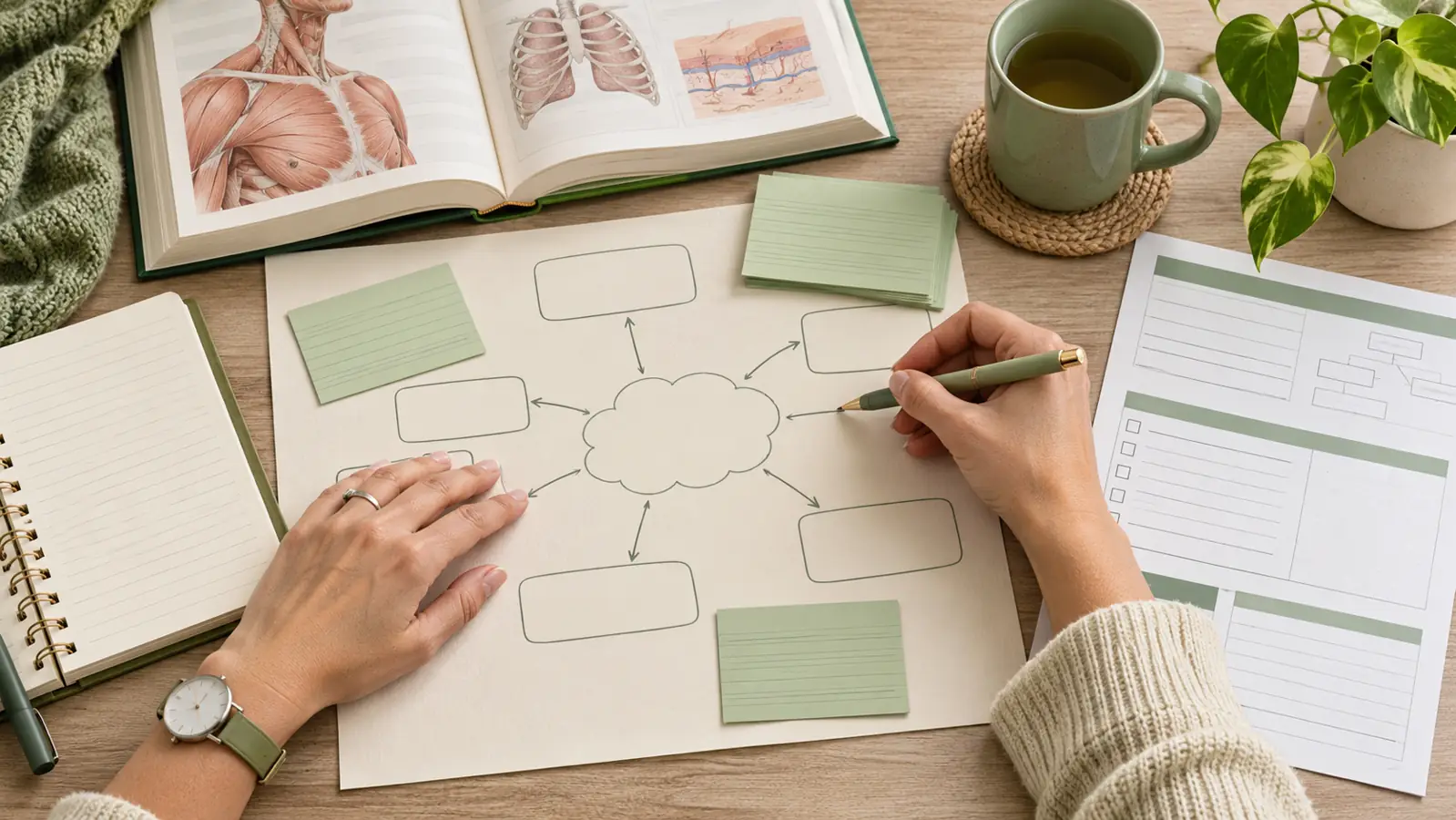
Copy a resource map and retrieval worksheet
Use the blank fields for your own subject. Add a genuine course outcome and a particular chapter or section, rather than a vague goal such as “finish anatomy.”
| Field | Your entry |
|---|---|
| Subject and learning outcome | ________________________________ |
| Prescribed or anchor source and section | ________________________________ |
| What I will produce without looking | ________________________________ |
| How I will check the answer | ________________________________ |
| Source date / date I checked it | ________________________________ |
| Correction and unresolved question | ________________________________ |
| Next attempt and result | ________________________________ |
A short session card
Before: I need to explain ______. My source is ______. During: Without looking, I can produce ______. After: The missing relationship was ______. I checked it in ______. My next task is ______.
Check the source before you build on it
Identify the author or publisher, the intended audience, the specific section and the update date. A university library directory, a textbook chapter and a research abstract serve different purposes. Do not treat a search result or a citation count as an answer key.
For literature searches, separate the study question, population, methods and findings. A single study may not settle a broad question. PubMed’s own description explains its citation and abstract role and links to its user guidance.
When the task is to explain a basic mechanism, begin with a suitable teaching source. When the task is clinical decision-making, use the required current guidance and supervised teaching for your setting. These foundation examples are educational, not patient-management protocols.
For an actual retrieval activity, use ten short-answer medical practice questions. For planning over several sessions, adapt the filled exam-preparation plan.

Frequently asked questions
Which medical study resources should I choose first?
Start with your course outcomes and prescribed material. Select one clear explanation source and one suitable retrieval activity for the immediate task. The directory below separates textbooks, literature search and practice resources.
Does a PubMed result provide the full article?
Not necessarily. PubMed primarily provides citations and abstracts, often with links to full text elsewhere. Check the linked journal or archive, the study design and the publication date before drawing a conclusion.
Are all the linked resources free?
The listed public textbook chapters and literature-search services can be opened without purchasing PhysioVeda membership. Full-text availability varies across literature records, and institutional library access may require a separate login.
Can I use the templates for any subject?
Yes. Replace the worked topic with a defined outcome from your own course. Record the source, the task you will attempt, what counts as a satisfactory answer and the next correction to check.
How are these resources different from revision notes?
A resource map tells you where to learn and how to check a particular outcome. Revision notes store the explanation and recall prompts. This kit includes small worked examples so you can connect the two.
What does PhysioVeda Full Access include?
The current plans list Anatomy, all available subjects and the 3D Anatomy Lab for the selected period: USD 141 for six months or USD 222 for one year. Check live terms, availability and inclusions before purchasing.
Continue with the appropriate learning format
Explore available subjects, try the Demo Test or browse the public upper-limb starter questions. Public samples and these worksheets are free to read; they are different from membership access.
Full Access currently lists Anatomy, all available subjects and the 3D Anatomy Lab at USD 141 for six months or USD 222 for one year. Cards marked Coming soon are not available study material. Check the current plans and terms.
View Plans & EnrollEditorial note and references
Prepared by the PhysioVeda Academics Editorial Team. Original prompts, model answers, examples and templates were checked against the linked sources on 5 November 2026. Source checking is editorial work; no independent qualified clinical or academic review is claimed. Photos illustrate adult learning and are not diagnostic diagrams.