
Medical Subject Summaries: Three Worked Study Sheets and a Template
Three ready-to-use summaries, worked examples and a one-page template.

These medical subject summaries give you three ready-to-use study sheets for foundational healthcare courses. Start with upper-limb movement in anatomy, predict cell volume in physiology, or work through the numbers in introductory pharmacokinetics. Each sheet gives you a quick reference, a worked example and a short check you can answer from memory.
What you can use today
- Match upper-limb movements to the joint and the muscles involved.
- Use the concentration of solutes that cannot cross the membrane to predict how a cell changes volume.
- Keep bioavailability, distribution, clearance and half-life separate by checking what each quantity measures.
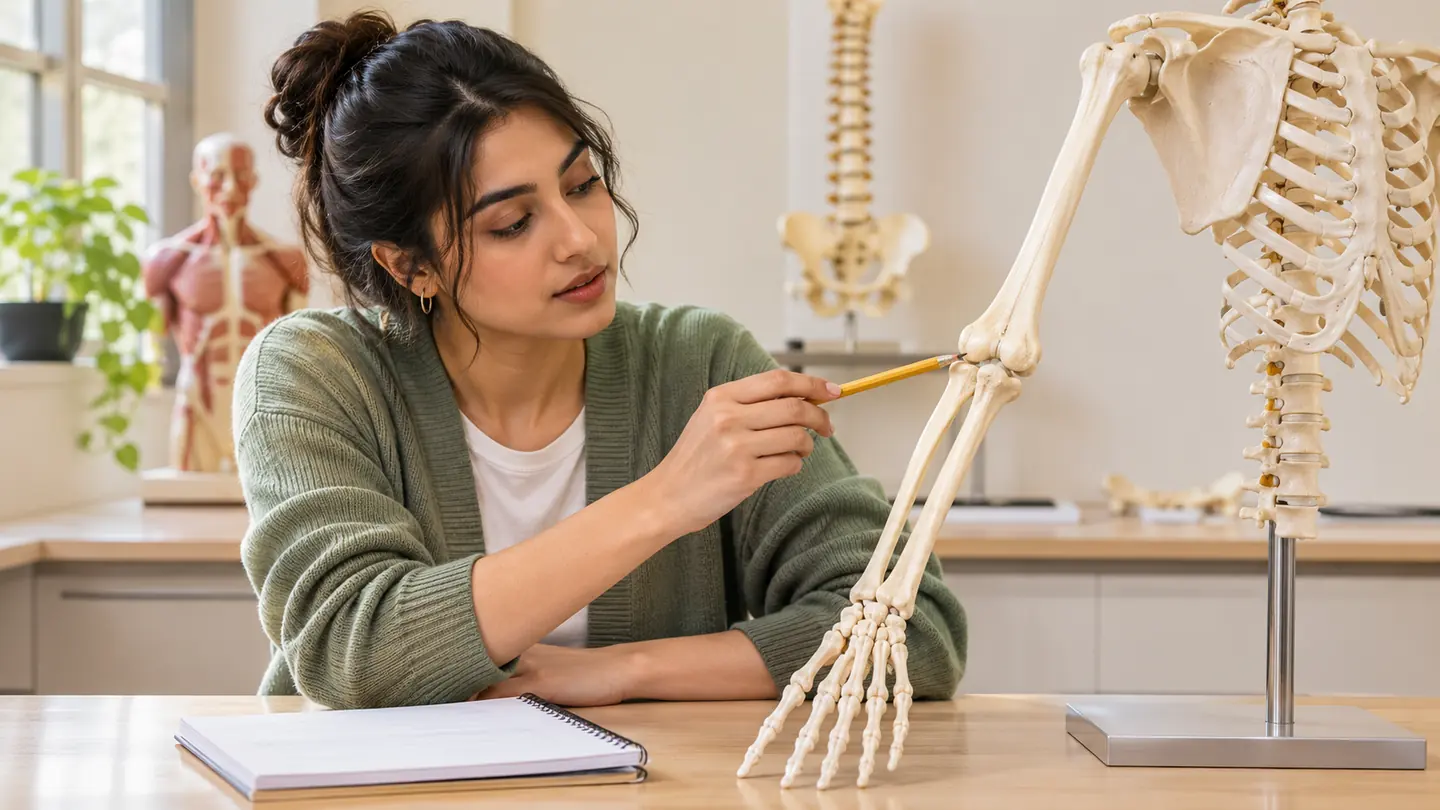
Anatomy summary for upper-limb movement
Start by naming what moves. A movement of the scapula along the chest wall is different from a movement of the forearm at the elbow or radioulnar joints.
| Movement | What moves | Structures to recall |
|---|---|---|
| Scapular protraction | The scapula moves forwards around the chest wall. | Serratus anterior contributes to protraction. Rhomboids draw the scapula towards the spine in retraction. |
| Elbow flexion | The angle between arm and forearm decreases. | Brachialis, biceps brachii and brachioradialis contribute. |
| Elbow extension | The angle between arm and forearm increases. | Triceps brachii extends the elbow, with assistance from anconeus. |
| Forearm supination and pronation | The radius rotates relative to the ulna at the radioulnar joints. | Biceps brachii and supinator contribute to supination. Pronator teres and pronator quadratus contribute to pronation. |
Worked example
Hold your elbow at about 90 degrees and keep your upper arm still. Turn your palm from facing down to facing up, then bring your hand closer to your shoulder. Name the two movements in order.
First, forearm supination changes the palm orientation at the radioulnar joints. Next, elbow flexion reduces the angle between the arm and forearm. Biceps brachii contributes to both movements, and brachialis assists with elbow flexion.
Which muscle contributes to the shoulder blade moving forwards when you reach a little farther?
Serratus anterior. The movement of the shoulder blade is scapular protraction.
Sources OpenStax, Muscles of the Pectoral Girdle and Upper Limbs
Explore the Anatomy subject hub
Physiology summary for osmosis and tonicity
Osmosis is net water movement across a selectively permeable membrane. Tonicity describes the effect a solution has on cell volume. For these examples, assume water crosses the membrane and the solute in question stays on its original side.
| Outside solution | Initial net water movement | What happens to the cell |
|---|---|---|
| Isotonic | There is no net movement. | Cell volume stays stable. Water still crosses in both directions. |
| Hypotonic | Water moves into the cell. | The cell swells. |
| Hypertonic | Water moves out of the cell. | The cell shrinks. |
Worked example
Place a red blood cell in a solution with a higher concentration of solutes that cannot cross its membrane. What changes first?
Water moves out, reducing the cell's volume. The outside solution is hypertonic relative to the cell under the stated conditions. The direction depends on the solutes that remain separated by the membrane.
If water crosses the membrane in both directions but cell volume stays stable, what is the net movement?
Zero. Individual water molecules still move, and there is no net gain or loss of water by the cell.
Sources OpenStax, The Cell Membrane
Explore the Physiology subject hub

Pharmacology summary for introductory pharmacokinetics
Use each quantity to answer a different question about what happens to a drug in the body. The calculations here use a simplified teaching model.
| Quantity | What it measures | Typical units |
|---|---|---|
| Bioavailability | The fraction of a dose that reaches systemic circulation unchanged. Delivery directly into systemic circulation by the intravenous route gives a value of 1. | Fraction or percentage |
| Apparent volume of distribution | The amount of drug in the body divided by its plasma concentration at the same time. | L |
| Clearance | The rate of drug elimination divided by the plasma concentration. | L/h or mL/min |
| Elimination half-life | The time for the plasma concentration to fall by half during first-order elimination. | Time, often hours |
Worked example
A model drug has a half-life of four hours and starts at 24 mg/L after distribution. With first-order elimination and no additional input, what concentration remains at 12 hours?
Twelve hours is three half-lives. The concentration goes from 24 to 12, then 6, then 3 mg/L. That is one eighth of the starting concentration. Each step halves the previous value.
If there is 120 mg in the body and the plasma concentration is 4 mg/L at the same time, what is the apparent volume of distribution?
30 L. Divide 120 mg by 4 mg/L. The result is an apparent volume that relates amount to measured concentration.
Sources The Bioavailability of Drugs, Biomolecules · StatPearls, Drug Bioavailability, equation 1 · StatPearls, Drug Clearance · Shinya Ito, Pharmacokinetics 101
Explore the Pharmacology subject hub

One-page medical subject summary template
Use one sheet for one learning outcome. The filled physiology sheet shows how to record the rule, its condition and a way to check your recall.
Filled example
| Field | Completed example |
|---|---|
| Subject and topic | Physiology, osmosis and cell volume |
| Course outcome | Predict the initial change in cell volume from the tonicity of an outside solution. |
| Core relationship | In a hypertonic solution, net water movement is out of the cell when the relevant solute cannot cross. |
| Condition that matters | The membrane lets water through and keeps the relevant solute separated. |
| Worked example | A red blood cell placed in a hypertonic solution initially loses water and shrinks. |
| Question to revisit | Which way would water move if the outside solution were hypotonic? Into the cell. |
| Source to check | OpenStax, The Cell Membrane, section on osmosis. |
Blank template to copy
SUBJECT AND ONE TOPIC

COURSE OUTCOME IN ONE SENTENCE

CORE RELATIONSHIP OR COMPARISON

CONDITION THAT MAKES IT TRUE

WORKED EXAMPLE AND ANSWER

ONE QUESTION TO REVISIT

SOURCE AND EXACT SECTION
Use the medical revision notes guide when you want to build a longer set of notes or write a follow-up recall task.
Continue practising
After reviewing the anatomy sheet, try 10 upper-limb anatomy MCQs.
These three summaries are free to use here. Explore the subject library or try the free demo for a sample of the practice format. For membership access and current terms, View Plans & Enroll.
Editorial note The PhysioVeda Academics Editorial Team prepared these foundational study examples using the sources linked on each sheet. Check the level of detail against your own course outcomes.
Frequently asked questions
What do these medical subject summaries cover?
They cover upper-limb movement in anatomy, osmosis and tonicity in physiology, and four introductory pharmacokinetic measures in pharmacology.
Can I read the three study sheets for free?
Yes. All three study sheets, their worked examples and the copyable template are available on this page.
Which summary should I study first?
Start with the topic in your next class or the one you find hardest. Try its recall check before reading the answer so you can identify what needs more work.
How do I turn a lecture into a one-page subject summary?
Pick one learning outcome, write the core relationship and the conditions that make it true, add a worked example, and save the exact reference section. Finish with a question you can answer without looking.
How can I check the accuracy of a summary?
Use the linked textbook section or pharmacology reference and compare it with your course material. Check the conditions, units and definitions before copying a relationship into your notes.
What can I practise after using a study sheet?
Try the matching Anatomy, Physiology or Pharmacology subject hub for more practice. Use the free demo to explore the format and check the plans page for Full Access.
Keep practising with PhysioVeda Academics
The materials on this page and the demo are free to use. Full Access includes available subjects, topic practice and the 3D Anatomy Lab for your chosen membership period.