
Oral Medicine
Oral medicine diagnoses and primarily manages disorders of oral mucosa, salivary glands, oral manifestations of systemic disease and nonodontogenic orofacial pain.
General subject summary is free to everyone.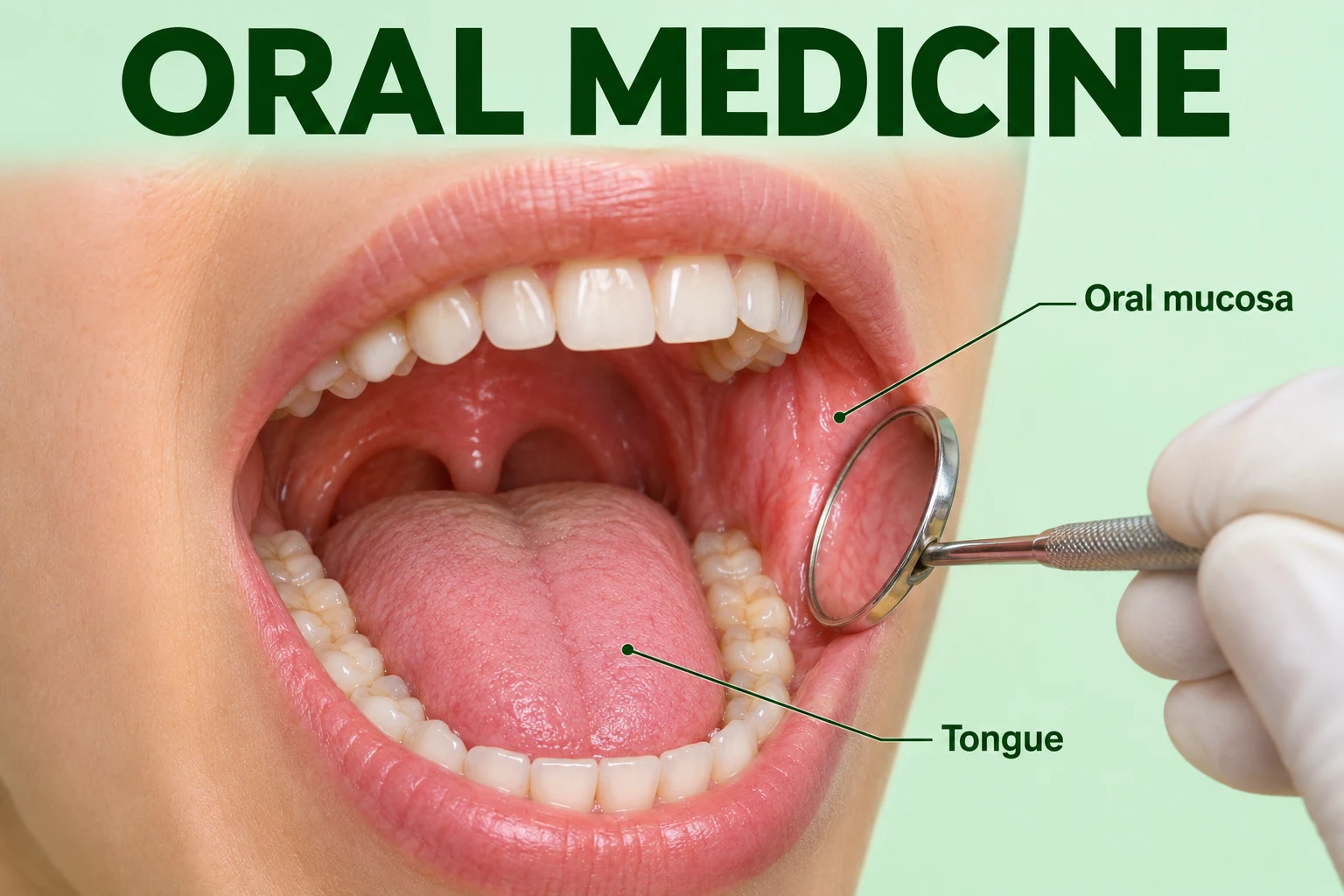
Oral Medicine
Subject Summary
The public overview below follows the supplied PhysioVeda Academics subject summary.
Oral medicine diagnoses and primarily manages disorders of oral mucosa, salivary glands, oral manifestations of systemic disease and nonodontogenic orofacial pain. In contrast, oral surgery emphasizes procedural management of dental, jaw and facial conditions, although the specialties overlap in diagnosis and referral. Presenting complaints include persistent patches or ulcers, soreness, swelling, altered taste, dry mouth and facial pain. A useful diagnostic pathway moves from history and systematic examination to a reasoned differential, targeted testing, response assessment and, where indicated, biopsy. Nonoperative care focuses on identifying causes, managing symptoms, removing risk factors and monitoring disease.
Core references
- Content is an educational expansion of the supplied PhysioVeda Academics topics and subtopics. Clinical decisions require current local protocols, individual assessment and referral where indicated.
- 1. Burket’s Oral Medicine. Consult a current edition for clinical diagnosis, oral-systemic conditions and nonoperative management.
- 2. Scully C. Oral and Maxillofacial Medicine: The Basis of Diagnosis and Treatment. Consult a current edition.
- 3. Neville BW, Damm DD, Allen CM, Chi AC. Oral and Maxillofacial Pathology. Consult a current edition.
- 4. National Institute for Health and Care Excellence (NICE). Suspected cancer: recognition and referral (NG12), section 1.8: head and neck cancers. https://www.nice.org.uk/guidance/ng12/chapter/Recommendations-organised-by-site-of-cancer
- 5. American Dental Association (ADA). Evaluation of Potentially Malignant Disorders in the Oral Cavity: 2017 guideline (archived; use with updated local guidance). https://www.ada.org/resources/research/science/evidence-based-dental-research/oral-cancer-guideline/
- 6. National Institute of Dental and Craniofacial Research (NIDCR). Temporomandibular Disorders: diagnosis and conservative care. https://www.nidcr.nih.gov/health-info/tmd
- 7. American Dental Association (ADA). Osteoporosis medications and medication-related osteonecrosis of the jaw: risk and dental care. https://www.ada.org/resources/ada-library/oral-health-topics/osteoporosis-medications
- 8. World Health Organization (WHO). Oral health: public health and disease-prevention overview. https://www.who.int/news-room/fact-sheets/detail/oral-health
- 9. Urgent referral timing, medicine selection, sampling and imaging should follow the current jurisdiction-specific pathways and professional scope.
- 34 topic-wise explanations and 34 high-yield revision tables, following the supplied PhysioVeda Academics outline.
- • Uploaded topic outline: Oral Medicine Topics and Subtopics.docx.
- • Uploaded subject summary: Oral_Medicine_Subject_Summary_PhysioVeda_All_Black.docx.
- • Correct answers and explanations use the uploaded source statements and high-yield tables.
- • Educational revision only; clinical decisions require assessment and current local guidance.
- • Normalized question-stem duplicates are checked across all topics; source concepts may recur.
Want to go deeper into Oral Medicine?
Continue into the complete topic and subtopic learning system with structured summaries, medical visuals, topic-wise MCQ practice, timed tests, explanations and results.