
Endodontics
The pulp-dentin complex is a continuous functional unit: odontoblasts line the pulp and form dentin, while dentinal tubules allow external stimuli and bacterial products to influence pulpal tissues.
General subject summary is free to everyone.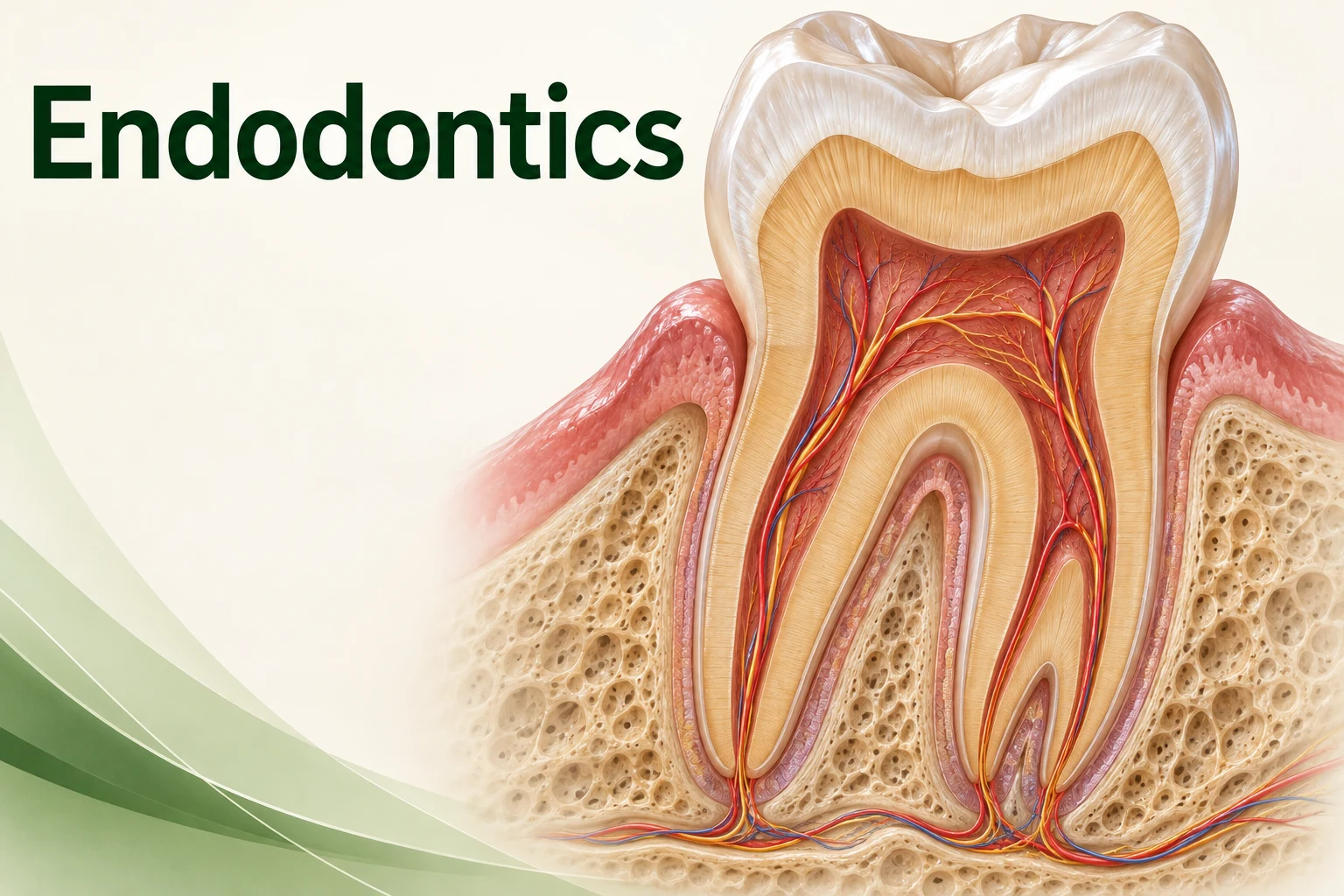
Endodontics
Subject Summary
The public overview below follows the supplied PhysioVeda Academics subject summary.
Subject explanation. The pulp-dentin complex is a continuous functional unit: odontoblasts line the pulp and form dentin, while dentinal tubules allow external stimuli and bacterial products to influence pulpal tissues. The coronal pulp chamber follows crown anatomy and projects toward cusps as pulp horns, especially prominently in younger teeth. Root canals extend from the chamber through the roots and may divide, merge or communicate via lateral and accessory canals. Apical anatomy includes an apical foramen, possible accessory foramina and a variable apical constriction; the radiographic root tip is not necessarily the canal's physiologic endpoint.
This educational summary expands the topics and subtopics in the supplied PhysioVeda Academics Endodontics outline. The source file provides headings rather than clinical explanations; the discussion and tables are supplementary general educational guidance informed by professional resources. Diagnostic terminology, local scope of practice and treatment protocols should be checked against current guidelines, training and patient-specific findings. This is not a substitute for supervised clinical instruction.
Core references
- 1. European Society of Endodontology (ESE). S3-level clinical practice guideline: Treatment of pulpal and apical disease (2023). https://pubmed.ncbi.nlm.nih.gov/37772327/
- 2. American Association of Endodontists (AAE). Clinical resources, guidelines and position statements. https://www.aae.org/specialty/clinical-resources/guidelines-position-statements/
- 3. AAE and American Academy of Oral and Maxillofacial Radiology. CBCT in Endodontics: 2025 update (published January 2026). https://doi.org/10.1016/j.joen.2025.09.008
- 4. American Academy of Pediatric Dentistry (AAPD). Pulp Therapy for Primary and Immature Permanent Teeth (2026). https://www.aapd.org/research/oral-health-policies--recommendations/pulp-therapy-for-primary-and-immature-permanent-teeth/
- 5. AAPD. Guideline for Use of Vital Pulp Therapy in Permanent Teeth (2025). https://pubmed.ncbi.nlm.nih.gov/41121563/
- 6. International Association of Dental Traumatology (IADT). 2020 dental trauma guidelines for permanent and primary teeth. https://iadt-dentaltrauma.org/guidelines-and-resources/guidelines/
- 7. American Dental Association. Antibiotics for Dental Pain and Swelling: Evidence-Based Guideline. https://www.ada.org/resources/research/science/evidence-based-dental-research/antibiotics-for-dental-pain-and-swelling
- 8. AAE. Endodontic competency and appropriate referral: clinical resources. https://www.aae.org/specialty/clinical-resources/
Want to go deeper into Endodontics?
Continue into the complete topic and subtopic learning system with structured summaries, medical visuals, topic-wise MCQ practice, timed tests, explanations and results.