
Dermatology
Dermatology examines how skin, hair, nails and cutaneous mucosa respond to inflammation, infection, injury, immune dysfunction, medicines and neoplasia. Accurate lesion description and distribution help build a diagnosis.
General subject summary is free to everyone.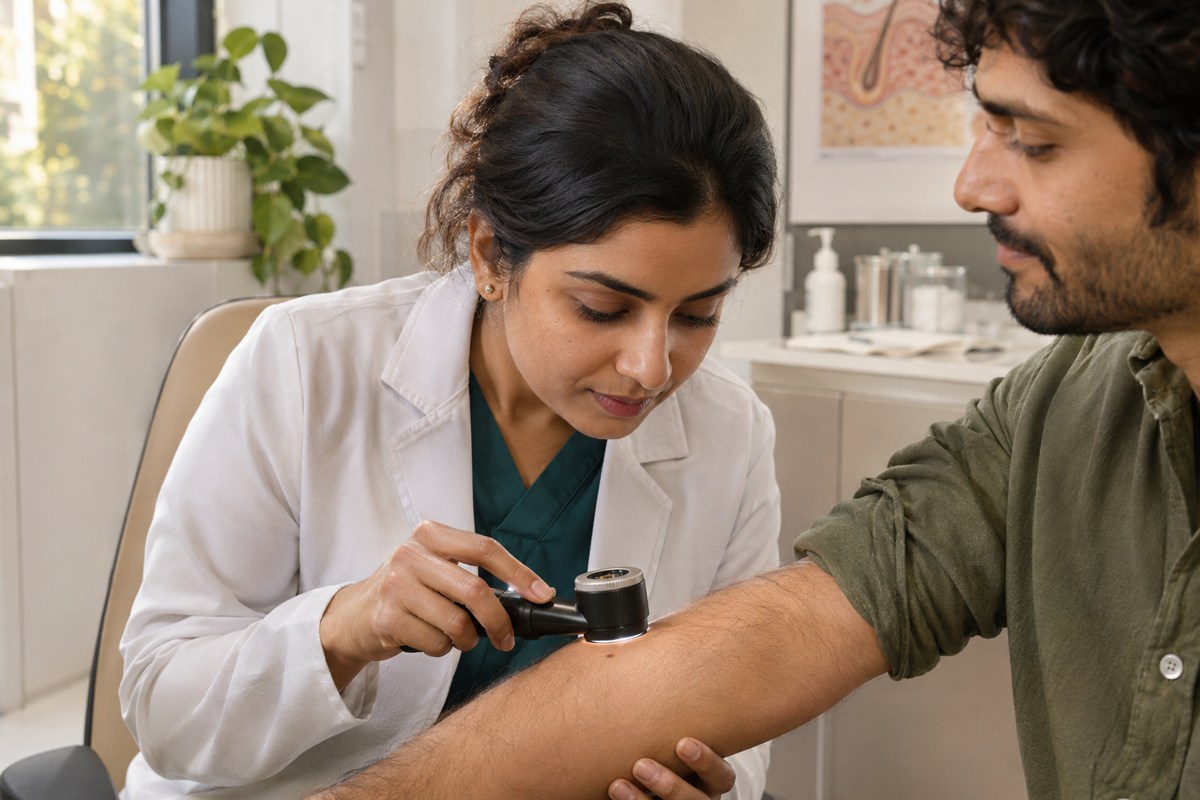
Dermatology
Subject Summary
The public overview below follows the supplied PhysioVeda Academics subject summary.
Dermatology examines how skin, hair, nails and cutaneous mucosa respond to inflammation, infection, injury, immune dysfunction, medicines and neoplasia. Accurate lesion description and distribution help build a diagnosis.
A practical clinical sequence is to characterize the patient and time course, describe primary and secondary lesions, assess systemic and mucosal warning signs, select appropriate tests and arrange treatment or referral within professional scope.
This summary preserves the 29 major topics and 174 subtopics in the uploaded PhysioVeda Academics Dermatology outline. Each section has an exam-focused overview, a high-yield table and an explanation for every original subtopic.
The uploaded document is a topic outline rather than a dermatology textbook. Explanations, safety notes and revision tables below are additional educational synthesis; they should be interpreted with clinician supervision, local protocols and current guidance.
Whole-subject high-yield numbers and concepts
Use these supplied values and key facts for quick whole-subject revision.
| Item | Number / key fact |
|---|---|
| Epidermis vs dermis | Epidermis provides barrier; dermis contains connective tissue, vessels and nerves. |
| Primary lesions | Macule, papule, plaque, nodule, vesicle, bulla and pustule. |
| Secondary lesions | Scale, crust, excoriation, erosion, ulcer, lichenification and scar. |
| Acute/chronic urticaria | Less than 6 weeks versus 6 weeks or more. |
| Melanoma ABCDE | Asymmetry, Border, Color, Diameter, Evolving; smaller lesions can be malignant. |
| Atopic eczema | Itchy relapsing inflammation with barrier dysfunction; emollients are basic care. |
| Scabies | Nocturnal itch, characteristic sites and contact history; coordinated contact care. |
| Skin cancer warning | New, evolving, irregular, bleeding or nonhealing lesion -> assessment. |
| Skin emergency | Painful blistering/mucosal lesions, purpura with illness or rapid necrosis -> urgent escalation. |
Core references
- Bolognia JL, Schaffer JV, Cerroni L, editors. Dermatology. Elsevier. (Comprehensive dermatology reference; use the current available edition.)
- Habif TP. Clinical Dermatology: A Color Guide to Diagnosis and Therapy. Elsevier. (Clinical lesion recognition and management overview.)
- Fitzpatrick's Dermatology. McGraw Hill. (General pathophysiology, clinical presentation and diagnostic principles.)
- American Academy of Dermatology. Atopic dermatitis clinical guideline (including topical-therapy guidance and subsequent updates): https://www.aad.org/member/clinical-quality/guidelines/atopic-dermatitis
- National Institute for Health and Care Excellence (NICE). Acne vulgaris: management (NG198; updated 2026): https://www.nice.org.uk/guidance/ng198
- Centers for Disease Control and Prevention. Scabies: prevention and care: https://www.cdc.gov/scabies/about/
- American Academy of Dermatology. ABCDEs of melanoma: https://www.aad.org/public/diseases/skin-cancer/abcdes-melanoma
- National Health Service (NHS). Stevens-Johnson syndrome: https://www.nhs.uk/conditions/stevens-johnson-syndrome/
- DermNet New Zealand. Dermatology clinical information and lesion terminology: https://dermnetnz.org/
- Education note: Diagnostic thresholds, formularies, testing availability and referral pathways vary by setting. Confirm current local guidelines and refer urgent or uncertain presentations for qualified assessment.
Want to go deeper into Dermatology?
Continue into the complete topic and subtopic learning system with structured summaries, medical visuals, topic-wise MCQ practice, timed tests, explanations and results.