
Physiotherapy MCQs: 10 Questions on Joint Movement
Name the joint action and plane from ten short movement observations.
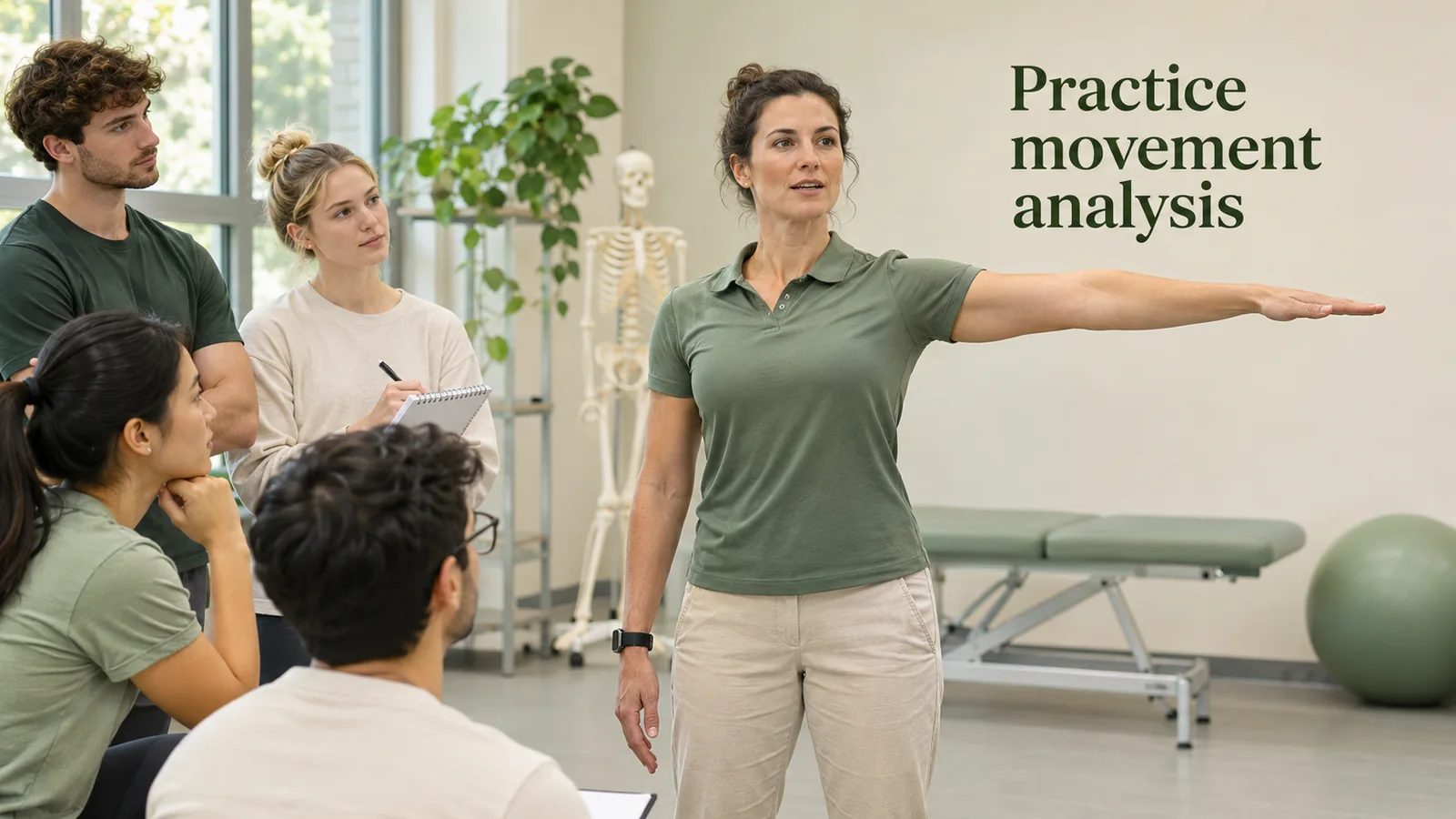
These free physiotherapy MCQs help you describe what you see before reasoning about muscle function. The ten introductory kinesiology questions cover the upper limb, lower limb and movement planes. Choose one answer for each observation, then open the explanation.
What you’ll practise
- Describe the action at the named joint from the movement you observe.
- Tell forearm rotation apart from shoulder motion.
- Distinguish ankle dorsiflexion and plantar flexion from foot inversion.
Physiotherapy MCQs on upper-limb movement
Question 1
An observer sees the angle between the upper arm and forearm decrease while the upper arm stays still. Which action occurs at the elbow?
- Extension
- Supination
- Flexion
- Pronation
Reveal answer to question 1
C. Flexion Elbow flexion decreases the angle between the upper arm and forearm. Pronation and supination turn the forearm without describing this change in elbow angle.
Source · OpenStax, Types of Body Movements · Flexion and extension
Question 2
With the trunk upright and the elbow straight, a learner raises an arm directly out to the side. Which action and plane describe the shoulder movement?
- Abduction in the frontal plane
- Flexion in the sagittal plane
- Adduction in the frontal plane
- External rotation in the transverse plane
Reveal answer to question 2
A. Abduction in the frontal plane The arm moves away from the midline to the side. That is shoulder abduction in the frontal plane. Raising the arm directly forward would be a different movement.
Source · OpenStax, Types of Body Movements · Abduction and adduction
Question 3
With the elbow held at 90 degrees and the upper arm at the side, a learner turns the forearm from palm-up to palm-down. What is the forearm action?
- Supination
- Wrist flexion
- Elbow extension
- Pronation
Reveal answer to question 3
D. Pronation During pronation, the radius crosses over the ulna as the palm turns down in this position. The elbow angle stays fixed.
Source · OpenStax, Types of Body Movements · Supination and pronation
Question 4
A learner holds a tray on an upturned palm with the elbow bent. Which action turned the forearm from thumb-up to palm-up while the upper arm stayed still?
- Shoulder external rotation
- Forearm supination
- Forearm pronation
- Wrist extension
Reveal answer to question 4
B. Forearm supination Forearm supination turns the palm up in this position. Keeping the upper arm still helps distinguish rotation of the forearm from rotation at the shoulder.
Source · OpenStax, Types of Body Movements · Supination and pronation
Question 5
With the upper arm at the side and the elbow bent, a learner moves the forearm outward while keeping the elbow against the trunk, the elbow angle fixed and the forearm in neutral rotation. What occurs at the shoulder?
- Adduction
- Flexion
- External rotation
- Internal rotation
Reveal answer to question 5
C. External rotation The humerus turns away from the body’s midline about its long axis. The bent forearm makes the rotation visible. The upper arm stays at the side, so the action is shoulder external rotation.

Lower-limb joint actions
Question 6
A seated learner straightens the knee until the shin points forwards. Which action and plane describe the movement?
- Knee extension in the sagittal plane
- Knee flexion in the frontal plane
- Knee extension in the frontal plane
- Knee flexion in the sagittal plane
Reveal answer to question 6
A. Knee extension in the sagittal plane Straightening increases the angle between the thigh and lower leg. That is knee extension in the sagittal plane.
Source · OpenStax, Types of Body Movements · Flexion and extension
Question 7
A standing learner begins with the right leg held out to the side. They bring it back toward the body’s midline without turning the thigh. Which action occurs at the right hip?
- Abduction
- Extension
- Internal rotation
- Adduction
Reveal answer to question 7
D. Adduction Hip adduction moves the thigh toward the midline. It can occur as the thigh returns from a position of abduction without crossing in front of the other leg.
Source · OpenStax, Types of Body Movements · Abduction and adduction
Question 8
A seated learner brings the top of the foot toward the front of the shin while keeping the knee and toes still. What is the action at the ankle?
- Plantar flexion
- Dorsiflexion
- Inversion
- Eversion
Reveal answer to question 8
B. Dorsiflexion Dorsiflexion brings the top of the foot toward the shin at the ankle. Pointing the foot down would be plantar flexion. Turning the sole inward would be inversion.
Source · OpenStax, Types of Body Movements · Dorsiflexion and plantar flexion
Question 9
A learner lifts the foot off the floor and turns the sole toward the other foot without turning the thigh. What is the foot movement?
- Inversion
- Eversion
- Dorsiflexion
- Plantar flexion
Reveal answer to question 9
A. Inversion Inversion turns the sole medially. Eversion turns it laterally. These motions occur through joints of the foot, whereas dorsiflexion and plantar flexion are ankle actions.
Source · OpenStax, Types of Body Movements · Inversion and eversion

Combining movements
Question 10
A learner keeps the elbow straight and draws a large circle in the air with the hand by moving at the shoulder. The shoulder is the centre of the movement. What best describes the combined action?
- Flexion
- External rotation
- Abduction
- Circumduction
Reveal answer to question 10
D. Circumduction In circumduction, the distal end of the limb traces a circle as flexion, abduction, extension and adduction combine. External rotation turns the humerus about its long axis.
Answer key
Describe a movement in three steps
Use the same sequence every time
Name the joint, describe the direction of movement and then name the action. Add the plane when the movement clearly fits one.
Worked example
A learner lifts the left thigh forwards while the pelvis stays still. Joint: left hip. Direction: thigh moves forwards relative to the pelvis. Action: hip flexion in the sagittal plane. Now try the same three steps for bringing that thigh back toward neutral.

Editorial note and sources
The PhysioVeda Academics Editorial Team prepared these original observation questions using the body-movement chapter of OpenStax Anatomy and Physiology 2e. Each explanation links to the relevant subsection.
Frequently asked questions
What level are these physiotherapy MCQs?
They cover introductory kinesiology and suit learners who are starting to name joint actions and movement planes.
Do I need an account to check the answers?
All ten questions, answer reveals and the answer key are available on this page.
Which plane describes raising the arm straight out to the side?
Shoulder abduction directly out to the side is a frontal-plane movement.
How can I tell forearm rotation from shoulder rotation?
Look at which segment turns. In forearm pronation and supination the radius moves relative to the ulna. In shoulder rotation the humerus turns about its long axis.
How do I tell dorsiflexion from inversion?
Dorsiflexion brings the top of the foot toward the shin. Inversion turns the sole toward the midline.
What should I practise after this set?
Use the kinesiology subject page to study planes, axes and functional movement. Try describing an everyday action such as climbing a step joint by joint.
Continue practising
Continue with the kinesiology subject hub or explore the physiotherapy practice hub. The demo test is free. Full Access plans cover the available subject library and 3D Anatomy Lab for the selected period.
Full Access is paid. View Plans & Enroll or review the access terms.